

Coffee Export Logistics
From Bean to Port, Perfected
Coffee export logistics — special green bean handling, temp-controlled ocean freight, and full supply chain care from Brazil's top farm regions to roasters worldwide.
Brazil ships 60 million bags a year — every one needs flawless logistics
As the world's top coffee grower, Brazil ships over 60 million 60-kg bags a year, worth $9+ billion. From the cerrado farms of Minas Gerais to the port of Santos, each link in the chain must guard quality. It must also meet plant health rules and land on time. We focus on moving green coffee from farm to buyer with zero quality loss.
What Suaid coordinates for this sector.
Operational details vary by commodity, market and deadline. These are the control points we keep in one freight thread.
Green Bean Handling & Grading
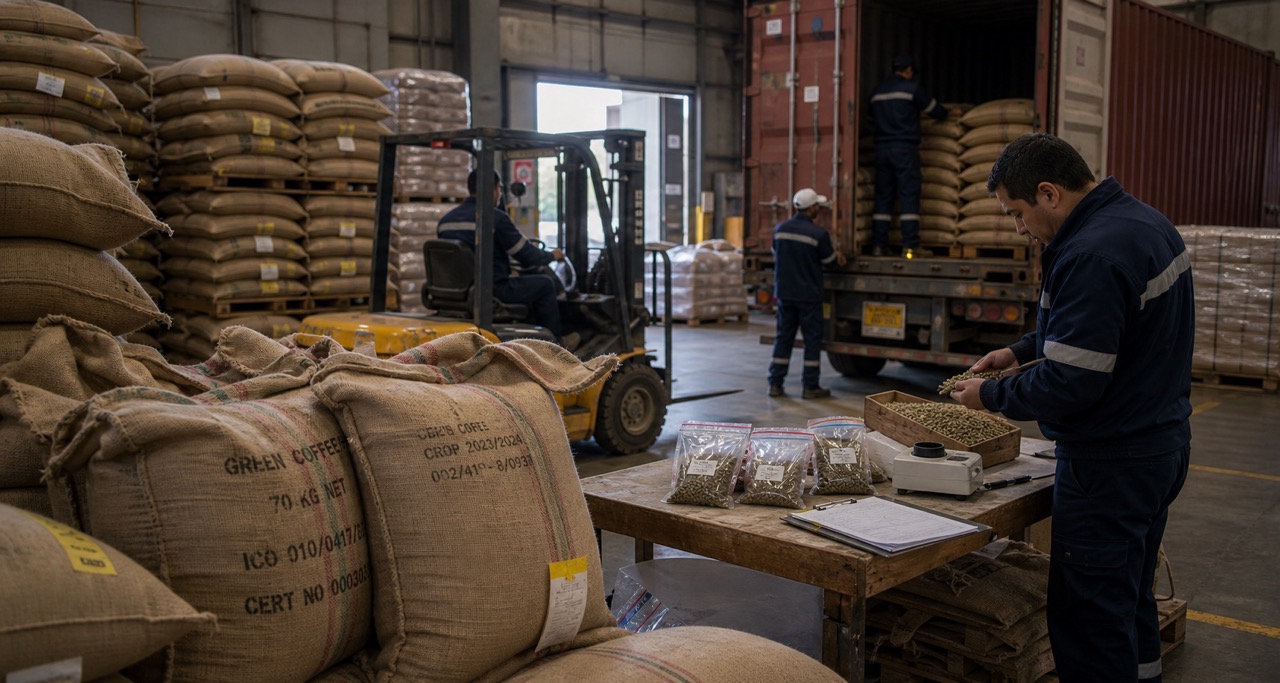
We work with certified depots and grading sites across Minas Gerais, São Paulo, and Espírito Santo. Each lot is tracked by ICO number, screen size, and defect count, so you get full trace-back from farm to ship.
Temperature & Humidity Control
Green coffee must travel at 60-70°F (15-21°C) with humidity below 65% to stop moisture uptake and mold. We use vented containers and check conditions all through transit to protect cup quality.
Port Logistics — Santos & Paranaguá
Santos handles over 70% of Brazil's coffee exports. We run booking, stuffing, and port slots at both Santos and Paranaguá, working around peak-season jams and terminal cutoffs to dodge costly rollovers.
ICO & Phytosanitary Certificates
Every coffee export from Brazil needs an ICO Certificate of Origin and MAPA plant health sign-off. We coordinate all the paperwork through licensed partners, including SISCOMEX filing, fumigation certificates, and the buyer country's import permits.
FCL Containerization with Liner Bags
A standard 20ft container holds about 250 bags (15 metric tons) of green coffee. We use GrainPro or Ecotact liner bags inside containers to seal in freshness and block moisture for up to 12 months.
Direct-to-Roaster Delivery Networks
Our partner network drops straight at roasting sites, co-ops, and specialty buyers across the US, Europe, and Asia. Ground partners handle the final leg, booking slots to match each roaster's production calendar.
Common lanes for this industry.
Use these as starting points. If your lane is not listed, Suaid can still route it through the global partner network.
Brazil → USA (Santos → Miami / New York)
The largest single-origin lane for Brazilian coffee. Transit time 15-20 days via direct services. Miami serves Southeast roasters; New York/New Jersey covers the Northeast specialty market. Section 321 de minimis does not apply — full customs clearance with FDA prior notice required.
Brazil → Europe (Santos → Hamburg / Trieste)
Europe brings in over 30% of Brazil's coffee output. Hamburg is the main gateway for Germany (the world's #2 buyer), while Trieste serves Italy's espresso trade. Transit time 18-25 days. EU plant health checks and EUDR (deforestation rule) compliance are required from 2025.
Brazil → Asia (Santos → Yokohama / Busan)
Growing demand from Japan (3rd wave specialty) and South Korea (café culture boom). Transit time 35-45 days via Cape of Good Hope or Suez Canal routing. Longer transit makes moisture control key — we use double-layer liner bags and extra desiccant on these routes.
Where shipments usually break down.
The work is not only moving cargo. It is removing the failure points that create holds, penalties and missed receiving windows.
Moisture Absorption During Ocean Transit
Green coffee draws moisture from the air around it. A shipment crossing the equator can see condensation (container rain) that pushes bean moisture from 11% to 13%, hurting quality. We cut this risk with liner bags, desiccants, and vented container picks.
Harvest Season Congestion (May–September)
Brazil's main coffee harvest runs May through September, driving a surge in export volumes. Santos port can see 5-10 day delays in peak weeks. We book vessel space 30-45 days ahead and use Paranaguá as backup to keep schedules on track.
Phytosanitary & MAPA Export Requirements
Brazil's farm ministry (MAPA) runs tight plant health checks on all coffee exports. Lots that fail face rejection, fumigation orders, or export bans. We prepare paperwork ahead and line up warehouse steps, so each shipment is ready for MAPA checks.
Premium vs. Commodity Grade Routing
Specialty coffee (scoring 80+ on the SCA scale) needs different care than commodity-grade beans. Top lots need lot-by-lot splits, careful temp control, and faster transit. We plan routes based on grade, value, and buyer needs.
Santos Port Delays & Terminal Congestion
Santos is Brazil's busiest port, moving over 4 million TEUs a year. During coffee harvest peak, terminal yards fill fast and vessel schedules slip. Our partner network works with several terminal firms and uses Santos Brasil, BTP, and DP World terminals to cut dwell time.
Services this industry uses most
Every service connects back to one accountable operating thread.
Ocean Freight
FCL and LCL services optimized for agricultural commodities with vessel booking, container tracking, and port-to-port visibility.
Customs Brokerage
Full customs clearance including ICO certificates, MAPA phytosanitary documentation, FDA prior notice, and destination-country import permits.
Warehouse Solution
Climate-controlled warehousing for green coffee storage, lot separation, sample management, and order consolidation before delivery to roasters.
Adjacent supply chains.
Food & Beverage
Temperature-controlled logistics, FDA compliance, and shelf-life management for food and beverage products.
Agriculture
Bulk agricultural commodity shipping with seasonal planning, phytosanitary compliance, and origin-to-destination traceability.
Chocolate & Cocoa
Temperature-sensitive supply chain for cocoa beans and finished chocolate products with similar handling and compliance requirements.
Common questions about Coffee Export.
Short answers for shippers comparing routes, documents, cost and service fit.
Send the lane. We'll shape the plan.
Tell us the commodity, origin, destination and timing. A coordinator who works Coffee Export freight reviews your request.
Get a Coffee Logistics Quote
Tell us your origin region, volume, and destination — we'll send a full proposal with vessel schedules, container specs, and all-in pricing.
Request a quote
Share the route, cargo and timing so the quote can state its scope and exclusions.
Start a quoteTalk now on WhatsApp
Use WhatsApp for route questions, quote follow-up or shipment details.
Open WhatsAppEmail the team
Include your shipment details and preferred contact information.
contact@suaidglobal.com