

Automotive Logistics
& OEM Supply Chain
Automotive logistics — JIT delivery, parts supply chain, and OEM rules. Special vehicle and part shipping by Suaid Global.
Your production line depends on logistics engineered for precision
The auto industry runs with zero room for delay. One part that misses its slot can shut down a whole plant and cost over $1 million a day. We know that pressure. We build logistics that match your JIT production pace.
What Suaid coordinates for this sector.
Operational details vary by commodity, market and deadline. These are the control points we keep in one freight thread.
JIT Milestone Tracking
Milestone tracking mapped to your factory production calendar. You get an alert as soon as an ETA slips, so you can replan before the line stops.
RoRo Vehicle Expertise
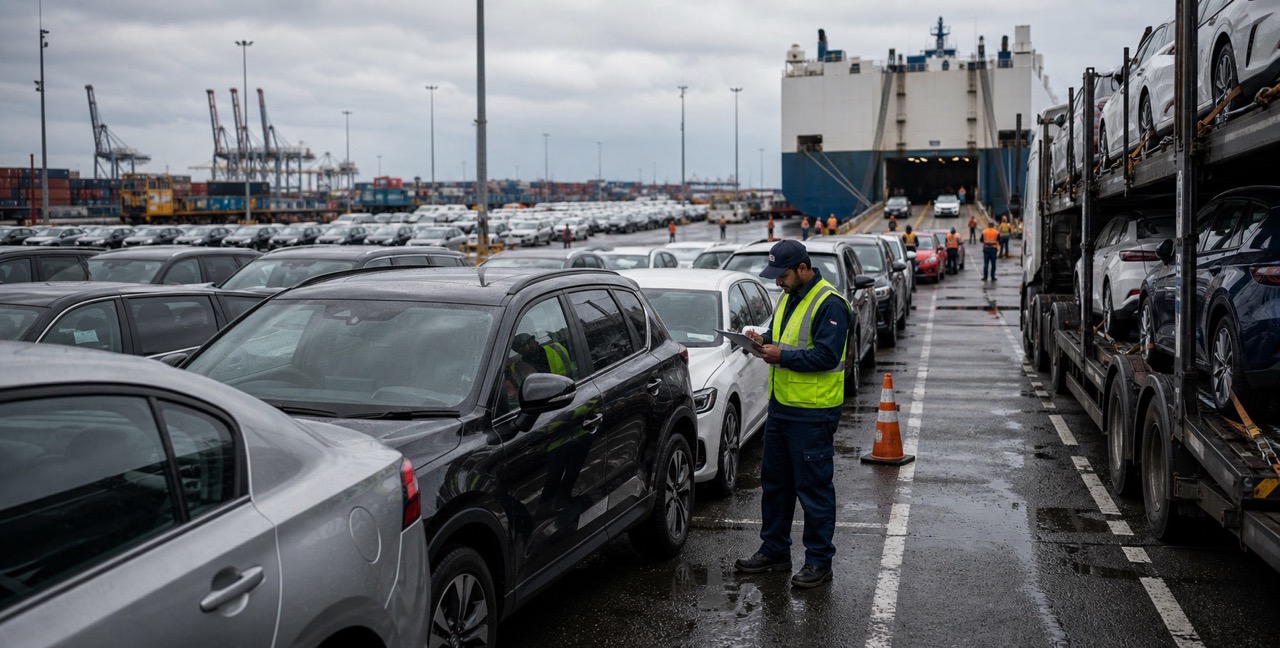
Roll-on/roll-off shipping for whole vehicles, heavy machines, and wheeled gear. Special paperwork, certified lashing, all-risk cover, and a check at each port.
EV Battery Handling (UN3481)
Lithium batteries need UN3481/UN3480 class codes, IMDG Class 9 packing, and DGD paperwork. Partner DG specialists run the full rule chain, aiming to move your EV batteries without holds or fines.
Cross-Docking for Auto Parts
CKD and SKD kits need perfect timing. Our cross-docking pulls parts from many suppliers, checks each kit is complete, and sends it straight to the line — no spare stock sitting idle.
Common lanes for this industry.
Use these as starting points. If your lane is not listed, Suaid can still route it through the global partner network.
Germany → USA
Countries: Germany. Key Ports: Bremerhaven, Hamburg → Savannah, Jacksonville. Products: BMW, Mercedes, VW parts. Rules: EU-US trade compliance, FMVSS.
Japan → USA
Countries: Japan. Key Ports: Yokohama, Nagoya → Long Beach, Portland. Products: Toyota, Honda, Nissan parts. Rules: hourly JIT precision, RoRo.
South Korea → USA
Countries: South Korea. Key Ports: Busan → Savannah, Baltimore. Products: Hyundai, Kia, Tier 1 suppliers. Rules: KORUS FTA, EV battery IMDG.
Mexico ⇄ USA
Countries: Mexico ⇄ USA. Key Ports: Laredo, El Paso, Nogales. Products: cross-border assembly for GM, Ford, Stellantis. Rules: USMCA compliance, fast clearance.
China → USA
Countries: China. Key Ports: Shanghai, Ningbo → Long Beach, Savannah. Products: EV parts, batteries, electronics. Rules: Section 301, UN3481, export controls.
Brazil → USA
Countries: Brazil. Key Ports: Santos, Paranaguá → Miami, Houston. Products: engines, transmissions, auto parts. Rules: certificates of origin, FMVSS.
How different automotive parts should move
An assembly line stops for a five-dollar clip as fast as for an engine. Mode choice follows criticality, not value.
| Part type | Usual mode | Planning note |
|---|---|---|
| Body panels and stampings | Ocean in racks | Bulky and light; racks return empty and cost space |
| Engines and transmissions | Ocean containerised | Heavy per cubic metre; watch container weight limits |
| Electronics and sensors | Ocean, air for shortages | Static and moisture protection needed |
| Batteries for electric vehicles | Regulated dangerous goods | Classification and packaging drive the whole plan |
| Tyres | Ocean, loaded loose or racked | Loose loading saves space but slows unloading |
| Aftermarket spares | Consolidated ocean | Many small suppliers; consolidation cuts cost |
Where just-in-time supply breaks
Automotive logistics runs with almost no buffer. These are the usual failure points.
- One port, one route — A single congested gateway can stop a plant. Keep a tested alternative lane on file.
- Returnable racks not tracked — Racks stuck at destination halt the next shipment at origin.
- Customs classification drift — The same part declared two ways across shipments invites an audit.
- Supplier packing changes — A new carton size quietly changes how many parts fit per container.
- Battery rules ignored — Electric-vehicle cells are dangerous goods. Treating them as general cargo stops the booking.
- No premium freight plan — When a line is at risk, air charter decisions must be pre-agreed, not improvised.
Automotive logistics terms
| Term | Meaning |
|---|---|
| Line-side delivery | Parts delivered directly to the assembly point, not to a store |
| Milk run | One truck collecting from several suppliers on a fixed loop |
| Returnable packaging | Racks and bins that cycle back to the supplier |
| Premium freight | Emergency air or express used to protect production |
| Knock-down kit | A vehicle shipped as parts for local assembly |
| Sequencing | Delivering parts in the exact order the line will use them |
Classification and origin in automotive trade
Automotive duty outcomes turn on two questions: what the part is, and where it counts as being from.
- Classify the part, not the vehicle — A bracket is a bracket. The car it belongs to rarely changes the code.
- Keep classification consistent — The same part declared two ways across shipments is the fastest route to an audit.
- Understand regional value content — Trade agreements often require a share of value from the region before duty-free entry applies.
- Keep supplier declarations current — Origin claims rest on supplier paperwork. Expired declarations invalidate the claim.
- Watch remanufactured parts — Rebuilt units follow different rules from new ones in several markets.
- Document tooling separately — Moulds and dies sent to a supplier are often treated as an assist and affect customs value.
Where shipments usually break down.
The work is not only moving cargo. It is removing the failure points that create holds, penalties and missed receiving windows.
Production Line Stoppage
Auto plants run on thin stock. A 24-hour delay can mean $1M+ in losses from a stopped line. Our logistics aim for precision in hours, not days. We track each key part from pickup to plant arrival.
EV Battery Regulations
Lithium batteries count as dangerous goods (IMDG Class 9). They need special packing, DG labels, a shipper's note, and carrier sign-off. One paperwork slip means a port hold and weeks of delay.
Multi-Tier Supplier Coordination
One vehicle has parts from 30+ suppliers in 10+ countries. Getting Tier 1, 2, and 3 suppliers to land in the same window takes a clear view and control most agents just don't have.
Customs Delays for Auto Parts
Wrong tariff codes, bad origin rules, and gaps in USMCA/KORUS FTA compliance cause most holds. We pre-check each shipment's code and get the paperwork right before cargo reaches port.
Services this industry uses most
Every service connects back to one accountable operating thread.
Project Cargo
Specialized transport for oversized automotive parts and equipment.
Customs Brokerage
Compliance management for automotive imports and exports.
Adjacent supply chains.
Common questions about Automotive.
Short answers for shippers comparing routes, documents, cost and service fit.
Send the lane. We'll shape the plan.
Tell us the commodity, origin, destination and timing. A coordinator who works Automotive freight reviews your request.
Keep your production line running with Suaid Global
Share your production schedule and supplier addresses. We'll draft a JIT plan.
Request a quote
Share the route, cargo and timing so the quote can state its scope and exclusions.
Start a quoteTalk now on WhatsApp
Use WhatsApp for route questions, quote follow-up or shipment details.
Open WhatsAppEmail the team
Include your shipment details and preferred contact information.
contact@suaidglobal.com