

Heavy Equipment Logistics
Specialized Handling, On Schedule
Heavy equipment logistics — excavators, cranes, and mining machines. Permits, flat rack transport, and on-site drop-off by Suaid Global.
Heavy equipment demands engineered logistics solutions
Heavy gear — excavators, cranes, dozers, farm machines, and mining kit — needs special handling, oversize permits, heavy-lift loading, and gear-specific transport plans. Stock freight moves don't fit. We build transport plans that move your gear safe, on time, and within the rules.
What Suaid coordinates for this sector.
Operational details vary by commodity, market and deadline. These are the control points we keep in one freight thread.
Oversize & Overweight Transport
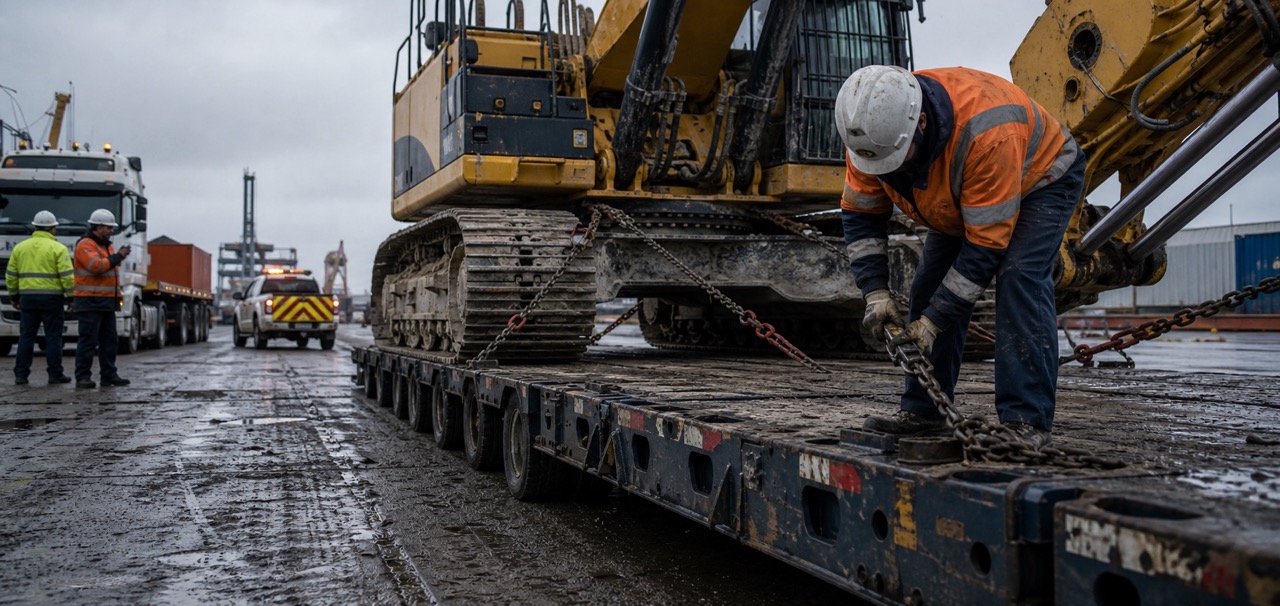
Flatbed, lowboy, and multi-axle trailers for gear up to 100+ tons. Oversize permits, route checks, and escort trucks as needed.
Crane Loading & Rigging
Custom crane work for load and off-load of heavy gear. Rigging staff keep lifts safe with zero harm to your asset.
Breakbulk & RoRo Shipping
Cross-border shipping by RoRo ship or breakbulk for big gear. Lashing, bracing, and marine checks included.
Permits & Regulatory Compliance
Oversize permits across all 50 US states and world routes. FHWA, state DOT, and custom route sign-offs run start to finish.
Common lanes for this industry.
Use these as starting points. If your lane is not listed, Suaid can still route it through the global partner network.
USA → Latin America (Construction Equipment)
Caterpillar, Komatsu, and John Deere gear to Mexico, Brazil, and Colombia. RoRo from Gulf ports. Import rules handled.
Europe → USA (Agricultural Machinery)
Combines, sprayers, and precision farm gear from Germany and Italy. RoRo or flat-rack from Hamburg to Gulf and East Coast ports.
China → USA (Mining Equipment)
Mining drills, loaders, and process gear. Breakbulk from Shanghai and Tianjin. Section 301 duty rules included.
USA → Middle East (Infrastructure Equipment)
Tower cranes, cement pumps, and road pavers to Saudi Arabia, UAE, and Qatar. Project cargo by ship from East and Gulf Coast.
Domestic USA (Multi-Site Construction Fleets)
Planned drop-off of gear fleets to many job sites. Oversize routes across state lines with full permit work.
Australia → Southeast Asia (Mining Equipment)
Haul trucks, excavators, and plant parts by RoRo and breakbulk from Australia ports.
Choosing between RoRo, flat rack, and container
Machines that drive can roll onto a vessel. Machines that do not have to be lifted. That single fact sets the cost.
| Machine type | Usual method | Why |
|---|---|---|
| Wheeled loaders and dozers | RoRo | They drive on and off, so no crane is needed |
| Excavators over container height | Flat rack or break-bulk | Too tall for a box even with the boom removed |
| Compact and mini equipment | Standard container | Fits once attachments come off |
| Cranes | Break-bulk, often part-dismantled | Boom sections ship separately |
| Agricultural machinery | RoRo or flat rack by size | Wide axles rule out standard boxes |
| Spare parts and attachments | Consolidated container | Cheaper to group with other cargo |
Preparing a machine for export
Most rejections at the terminal come from preparation, not paperwork. Work through this list before collection.
- Drain the fluids — Many carriers cap fuel at a quarter tank. Some require it empty. Confirm before the truck leaves.
- Disconnect the battery — A loose terminal on a rolling deck is a fire risk. Tape and secure it.
- Clean off all soil — Several countries reject machines carrying dirt or plant matter. Cleaning at destination is slow and expensive.
- Lower and lock attachments — Booms, buckets, and blades must sit in transport position and be pinned.
- Record the condition — Photograph every side before loading. This is your evidence if damage appears later.
- Confirm the true height — Measure with the machine in transport position, including any exhaust stack or beacon.
Terms you will see on a heavy-equipment quote
| Term | What it means |
|---|---|
| RoRo | Roll-on, roll-off. The unit drives aboard under its own power |
| Lashing | Chains and straps that hold the machine to the deck |
| Out-of-gauge | Cargo that exceeds container dimensions in any direction |
| Flat rack | A container base with no sides, used for oversized units |
| Static weight | The weight the deck must carry at each contact point |
| Wheeled unit surcharge | Extra charge for cargo that needs a driver on and off the vessel |
How used machinery is valued at import
Used equipment is where customs disputes concentrate. The declared value has to be defensible, not convenient.
- Transaction value first — Customs starts from what you actually paid. A sale between related parties gets extra scrutiny.
- Evidence of condition — Hour meters, service records, and photographs support a lower value. Assertions alone do not.
- Independent appraisal — For high-value units, a third-party valuation is often the fastest route through.
- Age and emissions rules — Several countries restrict or ban older engines outright. Check before you buy, not before you ship.
- Parts shipped separately — Attachments sent apart from the machine may be classified and taxed differently.
- Temporary import options — Equipment entering for a fixed project can sometimes avoid duty under a temporary regime.
Where shipments usually break down.
The work is not only moving cargo. It is removing the failure points that create holds, penalties and missed receiving windows.
Oversize Permit Complexity
Moving gear over 8'6" wide or 80,000 lbs asks for state permits, pilot cars, and route checks. One wrong permit brings costly holds at weigh stops.
On-Site Handling Requirements
Drop-off isn't done at the curb. Heavy gear needs crane off-load, set-up, and at times start-up work at the final site.
International Transport Regulations
RoRo booking slots, lashing sign-offs, and port entry rules shift by country. Paper gaps can ground your gear.
Timeline Coordination
Job sites run on tight clocks. Gear that lands one day late can stall a whole crew. Sharp timing is not up for debate.
Services this industry uses most
Every service connects back to one accountable operating thread.
Project Cargo & RoRo
International heavy equipment shipping by sea — RoRo, breakbulk, and flat-rack solutions.
Ground & Drayage
Domestic heavy equipment transport — oversize trucks, permits, and last-mile delivery to job sites.
Customs Brokerage
Import clearance for heavy equipment — tariff classification, bond, and duty optimization.
Adjacent supply chains.
Construction & Steel
Building materials, scaffolding, and prefab components that move alongside heavy equipment on job sites.
Energy & Renewables
Wind turbine components, solar installation equipment, and oil & gas machinery with similar oversize requirements.
Industrial & Machinery
Factory machinery, press equipment, and industrial assets sharing transport and handling requirements.
Common questions about Heavy Equipment.
Short answers for shippers comparing routes, documents, cost and service fit.
Send the lane. We'll shape the plan.
Tell us the commodity, origin, destination and timing. A coordinator who works Heavy Equipment freight reviews your request.
Moving heavy equipment? Let's plan the haul.
Tell us your gear specs, origin, and drop site. We'll draft the transport plan — permits, loading, routing, and drop-off — with our partner network.
Request a quote
Share the route, cargo and timing so the quote can state its scope and exclusions.
Start a quoteTalk now on WhatsApp
Use WhatsApp for route questions, quote follow-up or shipment details.
Open WhatsAppEmail the team
Include your shipment details and preferred contact information.
contact@suaidglobal.com