

Energy & Renewables Logistics
Heavy Cargo, DG Handling
Energy and renewables logistics — wind turbines, solar panels, and big oversized gear transport. Project cargo by Suaid Global.
Renewable energy logistics handle unique challenges
Energy and renewables shipping means oversized cargo (turbines, panels), battery handling under IMDG rules, and special gear. Project planning, heavy-lift ships, and dangerous-goods skill are a must. We run the full chain, from the factory floor to the install site.
What Suaid coordinates for this sector.
Operational details vary by commodity, market and deadline. These are the control points we keep in one freight thread.
Wind & Solar Heavy Transport
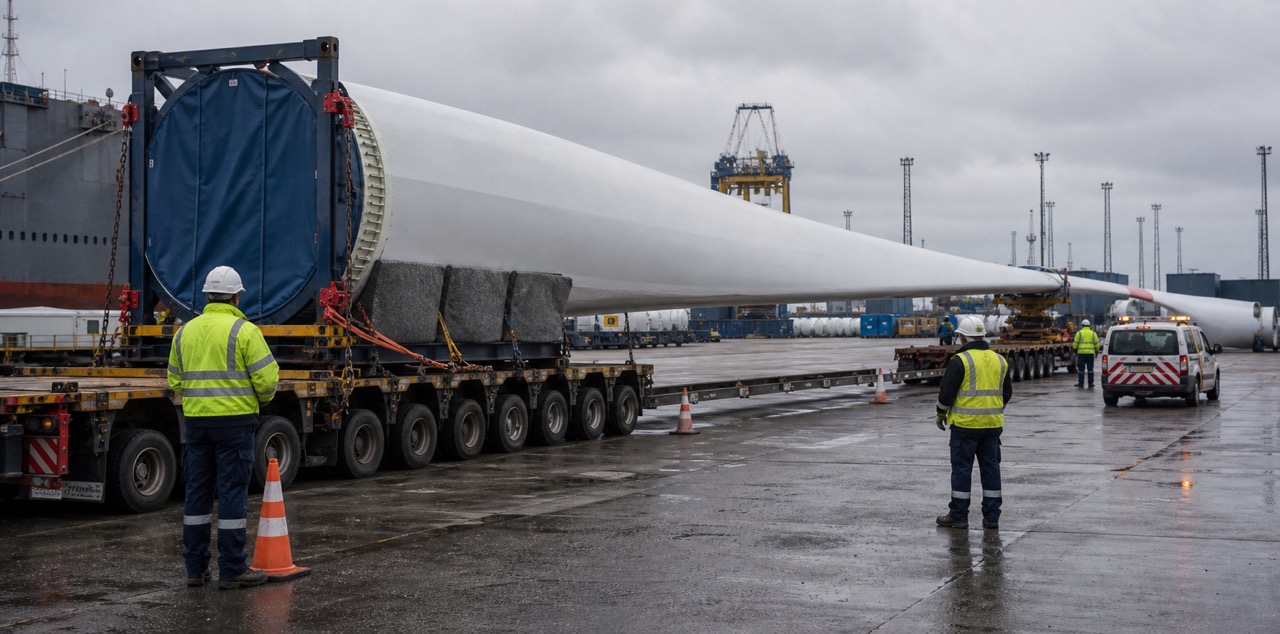
60–80m turbine blades, tower parts, nacelles, and solar panel racks move by project cargo ship, custom trailers, and night convoy runs with escort trucks.
Oil, Gas & Power Equipment
Pipe, valves, compressors, transformers, and drill gear. Hazmat DG sign-off for flammable and pressurized cargo. Port-to-offshore barge transfer set up end to end.
Lithium Battery & DG Compliance
UN3480/UN3481 lithium battery shipping with SOC (charge-level) limits, special stow rules, and IMDG forms. Big battery systems for power storage need their own ship plan.
Remote Site Logistics
Desert solar farms, offshore wind decks, and hill-country hydro sites have no set roads or ports. We plan last-mile drops to spots most freight firms won't touch.
Key Energy Equipment Import Corridors
Use these as starting points. If your lane is not listed, Suaid can still route it through the global partner network.
China → US
Solar panels, lithium battery packs, wind parts, and power gear. Ports: Shanghai, Tianjin → Los Angeles, Houston. Section 301 duty, AD/CVD on solar cells, and lithium DG forms.
Europe → US
Wind turbines (Vestas, Siemens Gamesa), offshore parts, and power gear. Ports: Esbjerg, Aarhus, Hamburg → Freeport TX, Boston. Project cargo ships, special port handling.
Brazil → US
Ethanol, bioenergy gear, and sugarcane plant equipment. Ports: Santos, Paranagua → Houston, New York. Biofuel duty class, big-gear OOG permits.
How each piece of renewable equipment travels
A solar farm and a wind farm need very different freight plans. The equipment decides the mode, not the budget.
| Equipment | Usual method | Key constraint |
|---|---|---|
| Solar panels | Containerised, stacked on pallets | Glass cracks under poor stowage; moisture ruins cells |
| Inverters and switchgear | Containerised, crated | Sensitive electronics; needs shock and damp protection |
| Wind turbine blades | Break-bulk or specialised vessel | Length far exceeds any container; road route must be surveyed |
| Nacelles and hubs | Break-bulk with heavy-lift gear | Point loads exceed normal deck limits |
| Transformers | Flat rack or break-bulk | Very heavy for the footprint; often needs a route study |
| Battery storage units | Containerised under dangerous goods rules | Lithium cells are regulated cargo end to end |
Where renewable projects lose time
Delays on energy projects rarely start at sea. They start on paper and on the road.
- No route survey — A blade fits the vessel but not the last bridge. Survey the road before you book the ship.
- Late permits — Oversized loads need permits from every authority on the route. Some take weeks.
- Mismatched delivery sequence — Foundations arrive after towers and the crane sits idle. Sequence the shipments to the build plan.
- Battery paperwork — Lithium units need test summaries and correct classification. Missing documents stop the container at origin.
- Crane windows — Heavy-lift cranes are booked by the day. A vessel that slips two days can cost a full crane hire.
- Weather seasons — Many sites have a fixed installation window. Freight planning has to work backwards from it.
Paperwork that travels with project cargo
| Document | Why it matters |
|---|---|
| Packing list with weights and dimensions | Drives lifting plans, permits, and stowage |
| Method statement | Tells the terminal how the piece must be handled |
| Lifting points diagram | Prevents damage during crane work |
| Certificate of origin | Decides duty treatment under trade agreements |
| Dangerous goods declaration | Required for any battery or chemical component |
| Marine insurance certificate | Project pieces are often single-source and slow to replace |
Why project cargo insurance works differently
A standard marine policy is built for replaceable goods. Project pieces are usually neither standard nor quick to replace.
- Delay in start-up cover — Covers the revenue lost when a late component pushes back commissioning, not just the part itself.
- Replacement lead time — A transformer can take many months to rebuild. The freight claim is rarely the real loss.
- Named perils versus all risks — Read which one you have. Handling damage is the most common claim and is not always covered.
- Survey requirements — Insurers often require an independent survey at loading. Skipping it can void a claim.
- Sue and labour costs — The cost of preventing further loss after an incident, which many shippers forget to claim.
- General average exposure — If the vessel declares general average, every cargo owner contributes, insured or not.
Key Challenges in Energy & Renewables Logistics
The work is not only moving cargo. It is removing the failure points that create holds, penalties and missed receiving windows.
Wind Turbine Blade Dimensions
New wind blades run past 80 meters long. Moving them takes custom ships, purpose-built trailers, night-only runs on open roads, and months of route work up front.
Lithium Battery Shipping Restrictions
UN3480/UN3481 battery loads face tight carrier limits, charge-level caps, and set stow rules. Air shipping of big battery packs is, in effect, off the table.
Multi-Country Equipment Sourcing
Towers from Denmark, blades from Spain, gearboxes from Germany, and control units from the US — all must land on-site in build order. One late part halts the whole build.
Remote and Offshore Site Access
Offshore wind decks, desert solar plots, and hill hydro jobs sit past normal transport reach. Jack-up ship charters, heli lifts, and off-road runs need to be set up well ahead.
Services for Energy & Renewables
Every service connects back to one accountable operating thread.
Project Cargo
Heavy-lift and OOG logistics for wind turbines, solar infrastructure, and power generation equipment of any size.
Ocean Freight
Breakbulk, flatrack, and charter vessel options for oversized energy equipment on all global trade lanes.
Value Protect
Specialized cargo insurance for high-value wind and solar equipment with all-risk and project cargo coverage.
Related Industries
Industrial & Machinery
Heavy manufacturing equipment and industrial machinery share the same OOG transport and project cargo logistics requirements.
Chemicals
Energy sector chemicals — lubricants, drilling fluids, and specialty gases — require the same DG compliance and hazmat handling.
Construction & Steel
Energy infrastructure construction uses the same steel, heavy materials, and project timeline logistics as commercial construction.
Common questions about Energy & Renewables.
Short answers for shippers comparing routes, documents, cost and service fit.
Send the lane. We'll shape the plan.
Tell us the commodity, origin, destination and timing. A coordinator who works Energy & Renewables freight reviews your request.
Power your project with Suaid Global logistics
From wind blades to lithium battery loads, we coordinate demanding energy logistics with project cargo partners, with no give on safety or rules.
Request a quote
Share the route, cargo and timing so the quote can state its scope and exclusions.
Start a quoteTalk now on WhatsApp
Use WhatsApp for route questions, quote follow-up or shipment details.
Open WhatsAppEmail the team
Include your shipment details and preferred contact information.
contact@suaidglobal.com