

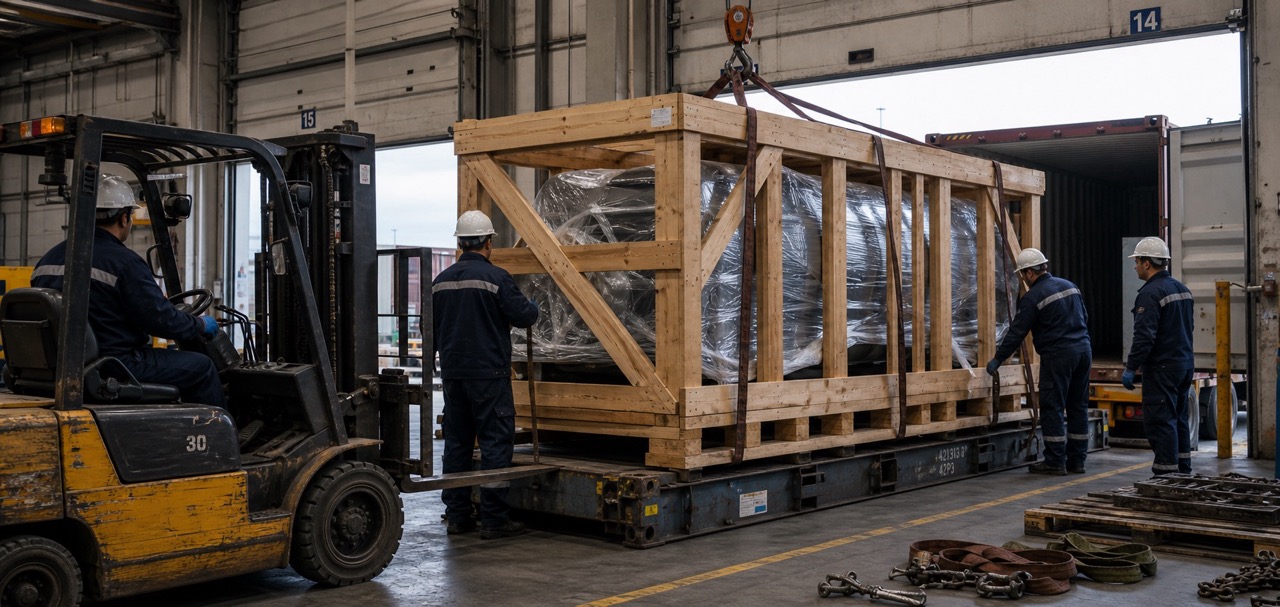
Industrial & Machinery Logistics
Heavy Equipment, Project Cargo
Industrial machinery shipping means oversized gear, flat rack containers, and heavy-lift moves. Suaid Global brings deep project cargo skill to each job.
Heavy machinery demands specialized expertise
Industrial and machinery logistics deal with big loads, heavy gear, and special handling needs. Breakbulk, project cargo, heavy-lift, and multi-mode transport all take real skill. We line up complex multi-supplier shipments with precise planning and the right gear.
What Suaid coordinates for this sector.
Operational details vary by commodity, market and deadline. These are the control points we keep in one freight thread.
Project Cargo & OOG Expertise
We handle out-of-gauge (OOG) machinery on flatracks, open-top containers, and breakbulk ships. Each oversized piece gets custom lashings, load math, and a pre-shipment survey.
Pre-Shipment Dimensional Surveys
We check weight and size at origin before booking. We run route studies for inland moves. This makes sure your gear clears every bridge and gate along the way.
Origin Stuffing Coordination
We coordinate on-site at the factory to load oversized gear into containers. This covers crane and rig oversight, brace and block plans, and lashing sign-off before the load ships out.
ATA Carnet & Specialized Documentation
We coordinate ATA Carnets for short-term equipment imports and re-import certificates through the issuing chambers and licensed partners. Heavy-lift port permits are arranged with terminal and project cargo partners. We also line up CE/UL sign-off paperwork for US equipment rules.
Key Industrial Machinery Import Corridors
Use these as starting points. If your lane is not listed, Suaid can still route it through the global partner network.
Germany → US
This lane moves precision machinery, CNC gear, tools, and presses. Ships leave from Hamburg and Bremen. They land in New York and Savannah. CE-to-US sign-off, ATA Carnets, and port heavy-lift apply.
Italy → US
This lane moves food processing gear, textile machines, marble-cutting tools, and robotics. Ships leave from Genoa and La Spezia. They land in New York and Baltimore. Food-contact gear needs FDA sign-up and CE marks.
Japan → US
This lane moves CNC machines, robotics, chip-making gear, and precision tools. Ships leave from Yokohama and Osaka. They land in Long Beach and Seattle. This freight is high-value, ESD-sensitive, and needs precise handling.
China → US
This lane moves factory gear, construction machinery, and industrial parts. Ships leave from Shanghai and Tianjin. They land in Long Beach and Houston. Section 301 duty risk and CE sign-off checks apply.
How machinery should be crated and secured
Machinery damage almost always traces back to the crate, not the vessel. These are the standard options.
| Method | Best for | Trade-off |
|---|---|---|
| Closed wooden crate | Precision machines and control panels | Heaviest and most costly option |
| Open slatted crate | Robust frames and welded structures | Cheaper, but offers no weather protection |
| Skid with shrink cover | Short lanes and simple units | Weak against handling shocks |
| Vacuum barrier bag | Sea freight of bare metal surfaces | Adds cost; prevents corrosion on long transits |
| Steel cradle | Very heavy or awkward shapes | Custom build; often reusable |
| Bolted to a flat rack | Units above container height | Needs a lifting and lashing plan |
Should you dismantle before shipping?
Dismantling saves freight and adds risk. Work through these points before deciding.
- Compare the height saved — If removing one part drops the unit under container height, the saving is usually large.
- Check who can rebuild it — Dismantling is only worth it if qualified people are available at destination.
- Protect every open port — Hydraulic and electrical connections must be capped the moment they are separated.
- Label to a numbered plan — Loose parts without a matching plan turn reassembly into guesswork.
- Keep calibration in mind — Some machines need recalibration after any move. Budget the engineer time.
- Watch the warranty — Manufacturers sometimes void cover if a third party dismantles the unit.
Terms on a machinery shipping quote
| Term | Meaning |
|---|---|
| Centre of gravity | Where the weight sits; drives the lifting plan |
| Shock indicator | A label that shows if the crate took a hard impact |
| Tilt indicator | Shows whether the unit was laid over in transit |
| Desiccant | Moisture absorber sealed inside the packaging |
| Lashing points | Fixed points designed to take securing straps |
| Out-of-gauge | Any dimension beyond standard container limits |
Planning the move beyond the port
For machinery, the last few hundred metres are usually the hardest part of the journey.
- Check every door and turn — Measure the building openings, not just the machine. This is the most common late surprise.
- Confirm floor loading — Some machines exceed the floor rating of the room they are meant to sit in.
- Book rigging early — Specialist riggers with the right gear are scarce and rarely available at short notice.
- Agree who unpacks — Crate removal, positioning, and levelling are separate jobs. Assume nothing is included.
- Plan power and services — A machine landed but not connected still counts as downtime.
- Keep the crate until commissioning — If the unit has to move again or go back, the original crate is worth keeping.
Key Challenges in Industrial Machinery Logistics
The work is not only moving cargo. It is removing the failure points that create holds, penalties and missed receiving windows.
Oversized Equipment Routing
Not every port takes OOG cargo. Inland routes need a bridge-height and weight check ahead of time. One route slip can strand million-dollar gear for a long time.
Port Crane & Heavy-Lift Availability
Heavy-lift cargo needs the right crane size at both ends of the route. Schedule clashes can delay a whole project. We book heavy-lift slots weeks ahead to avoid this.
Temporary Import & ATA Carnet
Machinery sent to the US for trade shows, tests, or short-term use needs an ATA Carnet. Miss the re-export window, and you face full duty charges plus fines.
Multi-Origin Equipment Assembly
Production lines can arrive from Germany, Italy, Japan, and the US at the same time. Timed delivery to the install site is key. One missing part can stall the whole line start-up.
Services for Industrial Machinery
Every service connects back to one accountable operating thread.
Project Cargo
Specialized heavy-lift and OOG logistics for machinery that doesn't fit in standard containers.
Ocean Freight
Flatrack, open-top, and breakbulk ocean freight for oversized industrial equipment on all major trade lanes.
Customs Clearance
HTS classification, ATA Carnet management, CBP machinery entry, and bond management for industrial equipment imports.
Related Industries
Energy & Renewables
Wind turbines, solar infrastructure, and power generation equipment share the same heavy-lift and OOG logistics requirements.
Automotive
Automotive manufacturing equipment — stamping presses, welding robots, assembly lines — requires the same project cargo expertise.
Construction & Steel
Construction machinery and steel fabrication equipment move through the same heavy-lift and OOG infrastructure.
Common questions about Industrial & Machinery.
Short answers for shippers comparing routes, documents, cost and service fit.
Send the lane. We'll shape the plan.
Tell us the commodity, origin, destination and timing. A coordinator who works Industrial & Machinery freight reviews your request.
Move your industrial equipment to the US with Suaid Global
From the factory floor in Germany to the install site in Texas, we coordinate each part of your machinery import with partners. That means surveys, heavy-lift, customs, and last-mile delivery.
Request a quote
Share the route, cargo and timing so the quote can state its scope and exclusions.
Start a quoteTalk now on WhatsApp
Use WhatsApp for route questions, quote follow-up or shipment details.
Open WhatsAppEmail the team
Include your shipment details and preferred contact information.
contact@suaidglobal.com