

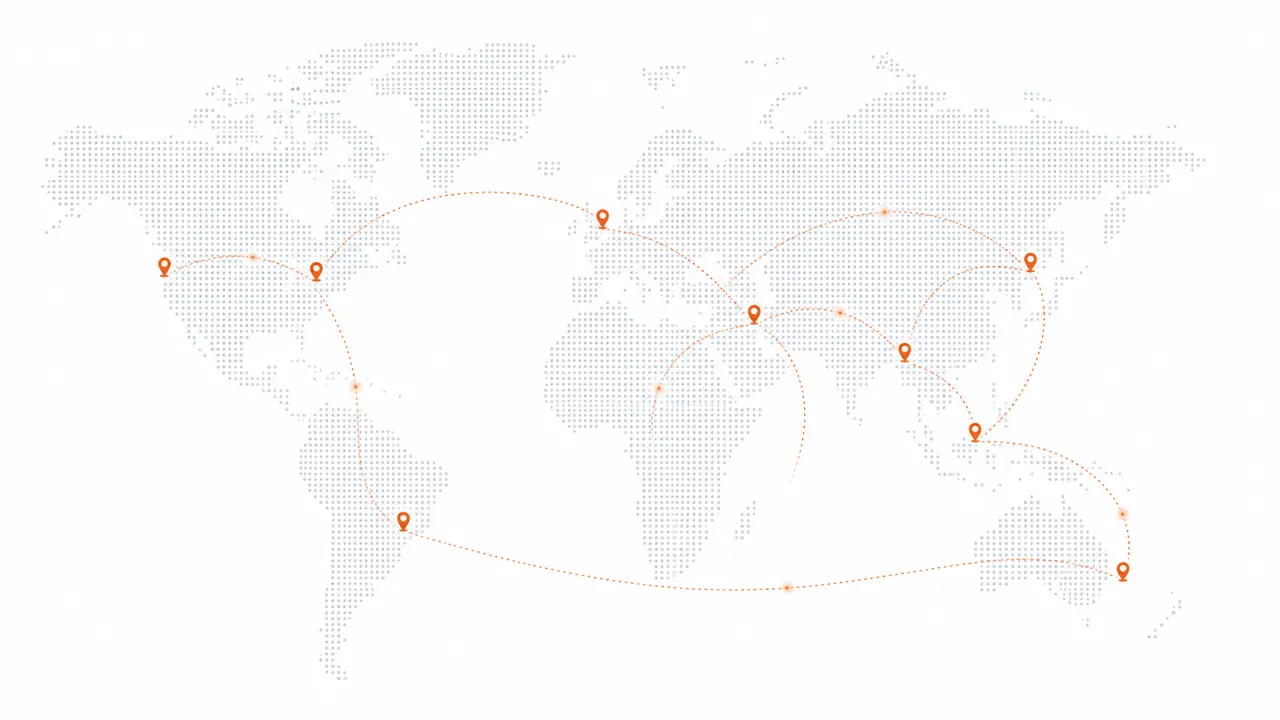
Shipping to and from Germany.
Europe's manufacturing powerhouse and logistics hub. Our partner network manages imports through Hamburg, Bremerhaven with full German customs, and provides central European distribution.
Germany freight, coordinated across the whole operating thread.
Germany is Europe's largest economy and manufacturing hub. The country is the primary gateway for goods destined to Central/Eastern Europe due to its rail and road infrastructure. Imports include machinery, raw materials, chemicals, electronics, and vehicles; exports focus on vehicles, machinery, pharmaceuticals, and precision instruments. German customs operates within EU NCTS system; clearance is efficient (1–2 days typical). Hamburg is Europe's 2nd largest container port; Bremerhaven is also major. Air freight through Frankfurt handles major European cargo volumes. Our partner network has strong presence in Germany with local distribution partners, and our licensed broker partners operate under German customs broker licenses.
Germany operates within EU customs framework (NCTS-Electronic). All imports via Hamburg/Bremerhaven use standard EU procedures. VAT 19% standard (reduced 7% for some items). Food/pharma require EU-wide compliance (no additional German requirements). Clearance is typically 1–2 days at Hamburg (EU's most efficient major port). Documentation must comply with EU standards. Rail transport to central/eastern Europe is primary advantage. Our licensed German Zollspediteur (customs forwarder) network handles local operations.
Annual imports referenced in the country profile.
Annual exports referenced in the country profile.
Trade position and market context.
Routing compared across ocean, air, ground, customs and partner options.
Port of Hamburg
Europe's 2nd largest container port (8+ million TEU/year). Germany's primary gateway. 1–2 day clearance.
Port of Bremerhaven
Major container port (5+ million TEU/year). North Sea gateway. 1–2 day clearance. Auto-focused.
Frankfurt Airport
Europe's largest cargo airport (2.1+ million metric tons/year). Global hub status. Premium positioning.
Berlin Brandenburg Airport
Berlin's main airport. Growing cargo hub. Eastern Europe gateway.
Munich Airport
Bavaria's major airport. Southern Germany gateway.
Frankfurt
Air cargo gateway — Frankfurt.
Berlin Brandenburg
Air cargo gateway — Berlin.
Munich
Air cargo gateway — Munich.
Cologne/Bonn
Air cargo gateway — Cologne.
What moves through Germany.
The freight plan changes by product category, Incoterm, customs regime and gateway. These are the trade patterns already documented for this market.
Frequent trading partners
Set up the German import file first
Most delays on a German import begin weeks before the vessel sails. They start with who is named on the entry. Fix that first, then book the freight.
- EORI number — Every importer of record in the EU needs one. Apply for it before the first booking, not on the day the box lands.
- Named importer of record — Decide early who clears the goods. A seller with no EU presence cannot hold that role on its own.
- Type of representation — A broker can file in your name, or in its own name. That choice decides who owes the duty if something is wrong.
- An Incoterm that matches the setup — DDP puts import duty and tax on the seller. Do not pick it unless the seller can register inside the EU.
- Import tax position — Import VAT is paid at entry and claimed back later. Only a registered party can claim it back.
- Product compliance owner — Many EU product rules ask for a named responsible person inside the EU. Agree who that is in the contract.
- Signed broker mandate — Nothing can be filed until the broker holds a signed authority from the importer.
- Classification agreed up front — Settle the tariff code with the supplier. Try the HS code lookup to compare candidates.
Which German gateway suits which cargo
Hamburg is not the right answer for every shipment. The best gateway depends on the cargo and on where the goods sleep that night. Inland trucking often costs more than the sea leg you saved.
| Gateway | Best fit | What to watch |
|---|---|---|
| Port of Hamburg (DEHAM) | Containers for northern, central and eastern Germany | A busy terminal. Book the inland truck early |
| Port of Bremerhaven (DEBMV) | Cars, rolling units and heavy project pieces | Vehicle terminals work on booked slots |
| Frankfurt Airport (DEFRA) | Urgent parts, medical goods and high value air cargo | Handling charges run higher than at small airports |
| Munich Airport (DEMUAC) | Cargo for Bavaria and the Alpine belt | Fewer long-haul freighters than Frankfurt |
| Berlin Brandenburg (DEBBB) | Cargo for eastern Germany and onward Polish routes | Smaller cargo footprint. Check capacity first |
| Cologne/Bonn (DECGN) | Express and courier volumes | Strong for parcels. Ask about pallet space |
| Any gateway, mixed cargo | Part loads that do not fill a box | Compare FCL against LCL before you book |
What happens after the box is discharged
Clearing the goods in Germany is only one option. The right regime depends on where the cargo really ends up. Pick it before arrival, because switching later means a new filing. See customs brokerage for how each entry is built.
| Regime | Use it when | Effect on your cost |
|---|---|---|
| Release for free circulation | The goods stay in the EU market | Duty and import tax fall due at entry |
| Transit under NCTS | The goods move on to another country | Duty is suspended until the office of destination closes it |
| Customs warehousing | You want to store before you sell | Duty waits until the goods leave the warehouse |
| Inward processing | Material is worked on, then sent out again | Relief on the part that leaves the EU |
| Outward processing | EU goods go out for repair or finishing | Duty on return is charged on the added value |
| Temporary admission | Tools, samples or fair stands go home again | No duty if the goods leave in the same state |
| Re-export from transit | Germany is only a corridor | No German import entry is filed at all |
Documents German customs expects, by cargo type
Every German trade line adds something to the base file of invoice, packing list and transport document. Build the file around the product, not around the invoice. The extra paper is easy to get at origin and slow to get later.
| Cargo | Beyond the base file | Common failure |
|---|---|---|
| Machinery and equipment | CE mark, EU declaration of conformity, technical file on request | The declaration is signed by a party with no EU address |
| Vehicles and auto parts | Certificate of conformity or type approval evidence | The chassis number on the invoice does not match the papers |
| Chemicals and plastics | Safety data sheet plus proof of REACH registration | No Only Representative appointed for a maker outside the EU |
| Medical and pharma goods | Licence of the EU importer and batch records | Temperature records missing when the goods land |
| Metals and minerals | Mill certificates and clear proof of origin | A preferential rate claimed with no statement on origin |
| Electronics | Conformity marks and waste take-back registration | Brand registered in one member state only |
| Any crated cargo | ISPM 15 heat treatment mark on all wood packing | Pallets stamped on one side, or dunnage left unmarked |
What really holds cargo at Hamburg and Bremerhaven
German clearance is quick when the file is clean. Almost every hold is clerical, not technical. Each item below is cheap to prevent and slow to unwind once the box has landed.
- A value that looks too low — Customs compares your invoice with market data. A thin invoice invites a query and a request for proof of payment.
- A vague goods description — Spare parts is not a description. Name the item, the material and what it is used for.
- Late broker instructions — The file should reach the broker before arrival. Sending it after berthing pushes the entry to the back of the queue.
- Two shipments on one invoice — When one container is queried, the second one waits with it. Invoice each shipment on its own.
- The container going back late — Detention runs on the box until it reaches the depot. Plan the unload and the return in one step.
- Inland transport booked late — Trucking into eastern Germany fills up around holidays and trade fairs. Reserve before the vessel arrives.
- Missing translations — Manuals and safety notices for consumer products are expected in German. Market checks happen after release.
Corridors that touch Germany.
Documented lanes with mode, customs and transit guidance drawn from the corridor data.
🇩🇪 Germany → 🇺🇸 United States
Ship by ocean or air from Germany's North Sea ports to US gateways. We move machinery, cars, chemicals, medicine, and precision tools, with full US customs clearance.
🇮🇳 India → 🇩🇪 Germany
We ship by ocean, or by air, from India's major ports to German gateways. This one lane moves textiles, pharmaceuticals, auto components, chemicals, and IT hardware too, all with full EU customs clearance.
Services available for Germany.
Germany guides and related logistics insight.
Freight Forwarding Cost Complete Breakdown for 2026
Freight forwarder fees and charges in 2026: ocean $1,500–$8,000, air $2.50–$8/kg, customs $150–$500 — every line item explained. Get a transparent quote.
How Much Does It Cost to Ship from China to Germany? Dated Prices by Mode
Dated China to Germany freight references by mode, import VAT and costs at the German port, and what changes the price. Send your cargo for a free quote.
Germany shipping questions.
Answered from the country profile and the operating requirements documented for this market.
Ask on WhatsAppAnything you need, we're here to help.
Talk to a real freight coordinator. Pick the channel that fits how fast you need an answer.
Request a quote
Share the route, cargo and timing so the quote can state its scope and exclusions.
Start a quoteTalk now on WhatsApp
Use WhatsApp for route questions, quote follow-up or shipment details.
Open WhatsAppEmail the team
Include your shipment details and preferred contact information.
contact@suaidglobal.com