
LCL Cargo Insurance: Coverage & Claims
Summary: Every year, 1-2% of ocean cargo shows up damaged, lost, or late. For LCL shipments, this risk is real — your pallets get handled 10+ times between origin and destination. This guide covers what cargo insurance pays for, what it costs, why carrier liability falls short, and how to file a claim when things go wrong.

Why LCL Cargo Insurance Is Essential
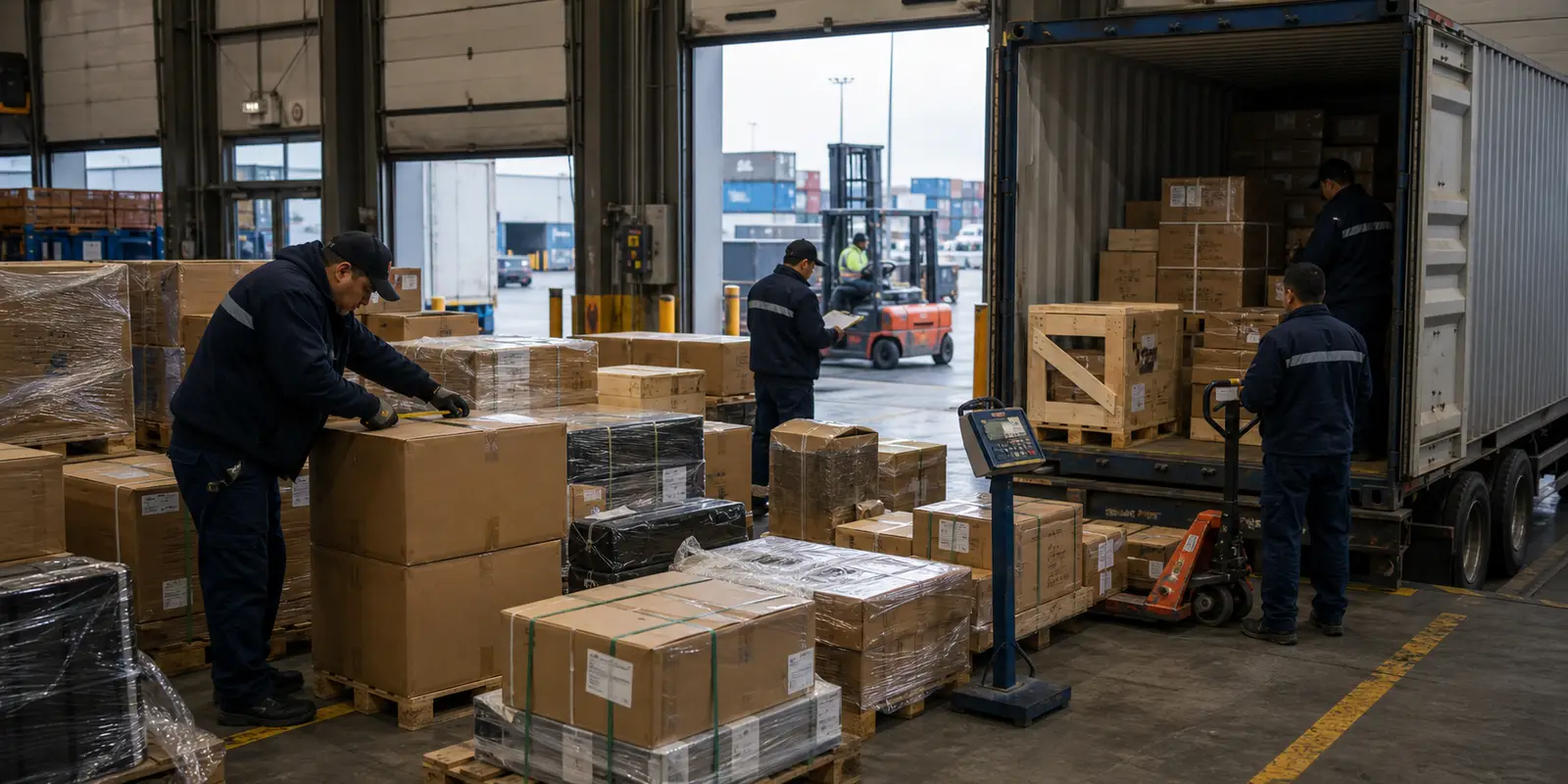
LCL cargo faces more handling risk than FCL, or full container load. In an FCL, your goods sit inside one sealed container from origin. In LCL, staff touch your pallets on their own, at least 15-20 times: at the load-in warehouse, at the origin port with a forklift, during ocean transit as the sea shifts the box, at the destination port on unload, and at the drayage warehouse, from break-down to loading onto a truck.
Each touch is a chance for damage. A forklift can miss a pallet and crush the corner. Rough seas can shift the load. A rough drayage driver can drop a pallet. Bad weather can seep into a vented container during a delay.
Here's the data: without cargo insurance, LCL shippers see a 1-2% total loss or damage rate, which covers partial damage, total loss, or theft. For a $100,000 shipment, that's a possible $1,000-$2,000 loss. Ship 12 times a year, and that adds up to $12,000-$24,000 in losses with no cover.
Carrier liability tops out at $500 per package under Hague-Visby, the global ocean shipping rules. Say your package is worth $5,000 and it arrives damaged: the carrier pays $500, and you eat the other $4,500. Cargo insurance closes that gap.
Carrier Liability Limits (Hague-Visby Rules)
Under Hague-Visby Rules, the global standard for ocean freight, a ship owner's liability tops out at $500 per package or unit, whichever runs higher. This cap is set by law, and you cannot negotiate it away.
What counts as a 'package'? Under Hague-Visby, a package means the smallest shipping unit. A pallet counts as one package, even if it holds 100 cartons inside. A lone carton counts as one package if you ship it on its own.
Example: you ship 5 pallets, each holding 50 cartons of goods. Each pallet counts as one 'package.' If damage hits, carrier liability tops out at $500 × 5 pallets, or $2,500 in total. If each pallet holds $20,000 of goods, you lose $97,500.
This cap applies unless you buy cargo insurance, or use a bill of lading with a 'full coverage shipper's declaration of value' clause. Even then, many carriers still ask for separate insurance.
Bottom line: never lean on carrier liability alone for LCL. Always buy cargo insurance once your cargo value tops $5,000 per pallet.
Types of Marine Cargo Insurance
Marine cargo insurance comes in three main types, each with its own price and its own scope of cover.
All Risk, or AR: the widest cover you can get. It insures against all physical loss or damage, except the items the policy leaves out by name, such as wear and tear, a flaw in the goods, poor packing, war, or strikes. You'll find these left-out items in the fine print.
What it covers: partial loss, total loss, water damage, weather damage, theft, breakage, contamination, mold, a drop, or a crush.
Premium: 0.5-1.0% of cargo value for standard goods, and 1.0-2.0% for high-risk goods such as electronics, drugs, or food.
Best for: high-value goods, fragile items, a long transit, or a shipper who wants the least risk.
Free Particular Average, or FPA: a narrower plan. It insures against total loss only, or a loss so bad it counts the same as total. It skips partial damage, breakage, or water damage, unless the event is a true disaster, such as a ship that sinks or a container lost at sea.
What's left out: partial loss, breakage, water damage, contamination, theft, a drop — anything short of a total loss.
Premium: 0.2-0.4% of cargo value.
Best for: tough goods, like metals, machinery, or containers, where a small dent is just cosmetic and the goods are easy to replace.
With Average, or WA: a middle-ground plan. It insures both partial loss and total loss, but only once the loss passes a set mark, often 3-5% of cargo value. Below that mark, you cover the loss yourself.
What it covers: partial loss above the threshold, total loss, water damage, breakage, and contamination.
Premium: 0.35-0.6% of cargo value.
Best for: mid-range goods, like apparel, consumer goods, or electronics, where you can live with a 3-5% damage risk.
How Much Does LCL Cargo Insurance Cost?
Insurers set your premium as a share of your cargo's declared value, often Cost + Insurance + Freight for DDP, or Cost + Insurance for CIF.
Formula: Insurance premium = Cargo value × Premium rate × (1 + markup factor)
Typical breakdown:
All Risk, or AR: 0.5-1.0% of cargo value, plus a broker or forwarder markup of 10-20%. Example: a $100,000 cargo at 0.7% gives a $700 base premium, plus a $140 markup, for $840 total.
Free Particular Average, or FPA: 0.2-0.4% of cargo value. Total with markup: $200-$480.
With Average, or WA: 0.35-0.6% of cargo value. Total with markup: $350-$720.
Additional factors affecting premium:
Route: a safer route, like China to the US West Coast, costs less than a risky one, such as a piracy zone or hurricane season. This often means a $50-$200 gap per shipment.
Commodity: fragile or high-value goods, like electronics, cosmetics, or drugs, cost 1.5-2.0x more. Tough goods, like metals or machinery, cost less.
Shipper history: a first-time shipper may pay a 15-25% markup. A repeat shipper with no past claims gets a 5-10% discount.
Deductible: a higher deductible, $2,500-$5,000, cuts your premium by 15-30%. A lower deductible, none or $500, raises your premium.
Real example: a 10-pallet LCL load from China to the US, 40 CBM, with a declared value of $100,000. All Risk insurance at 0.7% gives a $700 base plus a $100 broker markup, for $800 total. That adds just 0.8% to your landed cost.
How to Calculate Insured Value (CIF + 10%)
Insurance policies cover your 'insurable interest' — the value you would lose if your cargo never shows up. This is often Cost + Insurance + Freight, or CIF, plus a 10% buffer.
Why the 10% buffer? Because you don't just lose the cargo cost — you also lose the chance to sell it, your profit margin, and any handling cost. A $100,000 cargo that arrives damaged might cost you $110,000 in total impact, once you add the cargo, the lost margin, and a rushed reorder.
Calculation formula:
Insurable value = (Product cost + Ocean freight + Insurance) + (10% × product cost)
Example:
Product cost (CIF): $100,000.
Ocean freight (estimated): $6,000.
Insurance (estimated): $800.
CIF total: $106,800.
Insurable value: $106,800 + (10% × $100,000) = $106,800 + $10,000 = $116,800.
You declare an insurable value of $116,800. Lose the cargo, and you're covered up to $116,800, minus any deductible.
The underinsurance trap: declare $100,000 while your true value sits at $150,000, and lose the cargo, and the insurer pays only $100,000, leaving you $50,000 short. Always declare full replacement value, plus margin.
Overinsurance is allowed, but it still caps your payout at the real loss, on a pro-rata basis. Example: over-declare by $50,000 and lose the cargo, and you claim $150,000, but the insurer checks the real value at $100,000 and pays only $100,000, minus any deductible.
Filing a Claim: Steps & Timeline
- Document damage immediately: The moment you receive damaged cargo, get written proof from the drayage operator or the receiving warehouse. Take photos from more than one angle. Note the date, the time, the warehouse name, and any witness names. Do not open or use any damaged goods — an insurer can deny your claim if you change the cargo first.
- Notify insurer within 3-5 business days: Email your insurance broker or carrier in writing. Include the shipment reference, such as the bill of lading number, the date you got it, the date you found the damage, a short write-up, and photos. Wait too long, and your claim may go void — insurers hold firm 'notice' deadlines.
- File formal claim within 30 days: Send the claim form your broker gives you, with all the backup papers: the bill of lading, the commercial invoice, the packing list, the inspection report, any repair quotes, receipts for the damaged goods, and proof of value.
- Insurer conducts investigation (30-60 days): Your insurer may ask for more papers, more photos, or an expert check. Work with them fully. Do not toss the damaged goods until the insurer says it's fine — they may still need to inspect them.
- Insurer makes determination: The insurer accepts your claim in full, in part, or denies it, based on the policy terms and what they found. You get their decision in writing within 60 days of your full claim submission.
- Receive payment (7-14 days after approval): Get approved, and the insurer sends payment by bank transfer or check. The amount equals your declared value minus the deductible, or the real loss, whichever runs lower. Get denied, and you can appeal, or take it to arbitration.
Common Insurance Exclusions
Not every kind of damage gets covered. Know what's left out before you file a claim.
Wear and tear: normal aging, fading, odor, or a cosmetic mark stay outside cover. Example: your apparel arrives with a slightly worn corner from pallet handling. The insurer denies the claim unless there's real structural damage.
A flaw at the source: if the goods left the factory broken, insurance won't cover it. Example: electronics arrive DOA, or dead on arrival, not from transit damage, but because no one tested them at the factory. Denied.
Weak or wrong packing: admit that poor packing caused the damage, and the insurer can deny your claim. Example: you ship loose items with no pallet wrap, they shift in transit and break. The insurer argues that bad packing, not transit risk, caused the loss.
War, strikes, riots, civil unrest: any political event stays out of cover. Example: a port strike delays your shipment 3 weeks and the goods spoil. Excluded.
An unfit ship: an insurer may deny cover if the vessel was not fit to sail. This is rare, but it applies to old, poorly kept ships.
Detention and demurrage: storage delays and their fees stay outside cargo insurance. Example: customs holds your shipment 10 days and charges $5,000 in demurrage. Not insured.
Missing required papers: skip a DG declaration, a customs form, or any other required paper, and the insurer can deny your claim.
Hiding the truth: misstate your cargo, such as calling glassware 'machinery' to cut your rate, and the insurer can deny every claim you file.
To cut your denial risk: share every fact that matters, declare the true value, pack the goods right, get inspection reports, and tell your insurer fast when damage shows up.
Suaid Global Value Protect for LCL
Suaid Global offers 'Value Protect,' a simple cargo insurance option built for LCL shippers.
Features:
All Risk cover, the widest protection you can get.
Coverage kicks in on its own, for up to 1,000 CBM of LCL cargo a month, with no need to declare each shipment.
Declared value up to $500,000 per shipment.
Claim processing: the insurer sets the decision timeline under the policy terms, and a well-documented claim moves faster.
Deductible options: $0, $500, $1,000, or $2,500 — a higher deductible means a lower premium.
Premium: 0.6% of declared value, with no broker markup, for all-risk cover on international routes.
Example: a $100,000 LCL shipment, with a $0 deductible, costs $600 for full cover. That adds less than 1% to your total landed cost.
How Value Protect works:
Book LCL with Suaid Global, and you can add Value Protect right at checkout or at the quote stage.
Declare your cargo value, and the insurance certificate is issued under the policy terms.
If damage happens, send photos and an inspection report within 5 days.
The claim decision and payment follow the insurer's timeline and the policy terms.
We coordinate the claim paperwork with the insurer for you.