
40-Ton Project Cargo — Hamburg to South Carolina.
How we moved oversized industrial equipment across the Atlantic with zero damage and ahead of schedule.
The Challenge
A tier-2 automotive supplier in Stuttgart needed to ship a 40-ton hydraulic stamping press to a new plant in Spartanburg, South Carolina. The press measured 4.2m × 3.1m × 3.8m. That is well past the limits of a standard ocean container. It also had a hard installation deadline tied to the plant commissioning schedule. The move had to work on the first attempt.
Cargo of that size does not travel like normal freight. It has to move as breakbulk, on a flat rack, or on a roll-on vessel. Each option comes with its own booking rules, lifting gear and lashing plan. The choice made in week one decides how many times the press gets lifted later. Every extra lift is both a cost line and a risk line.
The road legs were as hard as the ocean leg. Oversize loads need route surveys and permits on both sides of the Atlantic, and the rules change by state. Planners have to check bridge loads, height clearance and escort vehicles before they pick a date. Permits also carry lead times, so the road plan has to be settled before the vessel is booked. A permit window that slips can leave a loaded truck parked for days.
The clock was the real constraint. The incumbent logistics provider quoted 8–10 weeks and could not commit to that window. Every week of slippage was worth an estimated €50,000 in plant commissioning delays. Automotive programs run to fixed start dates, and crews, utilities and line trials were all booked around one install day. So the brief was short: beat the quoted window, and hold the date.
The equipment itself carried the second risk. A stamping press is one-off capital equipment with a long build time. Damage in transit is therefore not just a repair bill. It would push the plant start out further than any freight delay could. Handling, lashing and cargo cover mattered as much as speed.
The Solution
Suaid Global designed a door-to-door project cargo move on the Germany to USA lane, planned backwards from the install date. The scope ran from factory pickup in Stuttgart to the handoff on the plant floor in Spartanburg. Every leg was booked around that one fixed milestone. Working backwards also exposed the long-lead items first, which were the permits and the deck space. The cheapest sailing was not the deciding factor.
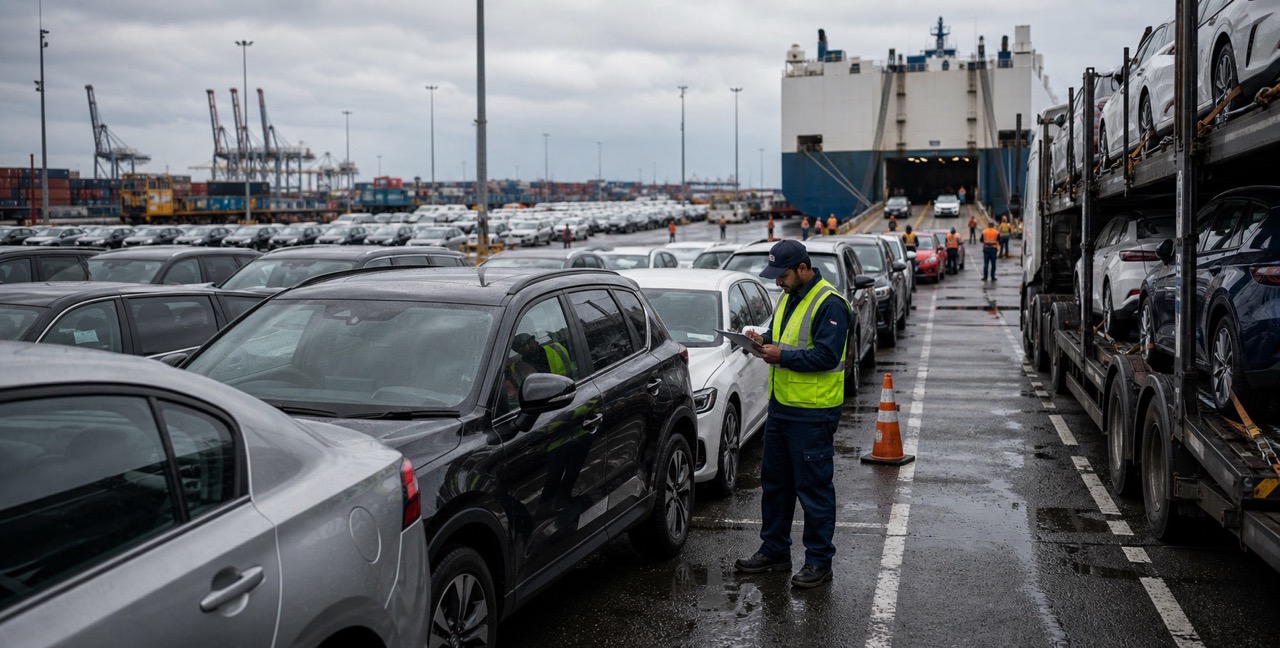
The press moved on a roll-on vessel with dedicated deck space and a lashing plan. That choice was about risk, not only cost. A lift-on move would mean a heavy crane lift at each end. Every lift adds a hazard and a booking dependency on port gear. Rolling the press on cuts the number of lifts and keeps the load on one trailer bed.
Hamburg was used because the port handles roll-on and out-of-gauge cargo as routine work. A specialized flatbed took the press from the factory to the quay under German oversize permits. On the US side, permitted heavy-haul transport carried it to Spartanburg on a surveyed route with escorts. Both road legs were mapped before the booking was confirmed, not after. That also fixed the pickup date at the factory, since the press could only leave once its permits were live.
Customs was treated as a scheduling item rather than paperwork. Licensed customs broker partners prepared the US entry and the AES filing for the machinery before the vessel sailed. A hold at the port would idle escorts, permits and a booked crane window at the plant. Classification and valuation questions were therefore settled on paper first. Clearing a press is a document job, and documents can be fixed early.
Cover and handoff closed the plan. Marine cargo insurance was placed on the press through Value Protect. It was sized to the value of the machine, not to a flat freight rate. Delivery was then coordinated on site with the plant's own installation crew. The truck arrived on the day the rigging team was ready for it.
Services Used
How the Program Went Live
The program started with a data pass, not a booking. Suaid Global collected the press drawings, the exact weights, the lifting points and the center of gravity from the supplier's plant engineers. Those numbers drive everything downstream. They set the trailer choice, the lashing points, the permit applications and the crane plan at delivery. Getting them wrong in week one shows up as a stopped truck in week four.
Documents were built in parallel with the transport plan. The export file, the commercial invoice, the packing list and the HS classification for the machinery were prepared as one package. The document set went to licensed customs broker partners early. That way the US entry was ready to lodge before arrival instead of after it. Nothing on the critical path was waiting on a missing form.
Operations ran on a single point of contact and a fixed cadence. The supplier had one weekly checkpoint plus milestone updates at each hard step. Those steps were factory pickup, port gate-in, vessel departure, arrival, customs release and final delivery. Milestone reporting was chosen over a live tracking screen on purpose. On a project move, the question that matters is whether the next permit and the next crane slot still line up.
The plan was re-checked every time the schedule firmed up. Oversize permits are valid for set dates and set routes. A shifted sailing can therefore invalidate a road leg that was already approved. Each vessel update triggered a fresh check of permits, escorts and the delivery window with the receiving plant. That loop is the difference between a schedule on paper and a schedule that holds.
The last mile was run to the crew's clock. The confirmed delivery window went to the plant before the truck left the port. Rigging and crane time could then be locked without guesswork. Suaid Global stayed on the handoff until the press was set down and signed for by the installation team. The plant engineers took over a machine that was ready to place, not a shipment to sort out.
The Results
The press ran door to door in 6 weeks. That figure covers the road legs, the sailing and the customs step, not just the ocean transit. That is 2 weeks inside the best case the incumbent quoted, and 4 weeks inside the worst. The plant commissioning schedule went ahead as planned. That outcome was the point of the whole design, and every routing choice was made to protect it.
The time saved is what the €50K+ figure is really about. By the supplier's own estimate, each week of delay would have cost around €50,000 in stalled commissioning. Two weeks of buffer therefore turned into budget that stayed unspent. The alternative was paying standby crews and idle utilities while the press sat in transit. That is the practical value of a lane plan built around a date rather than a rate.
The press arrived in perfect condition, with zero damage recorded. That result traces back to the modal choice and the lashing plan. Fewer lifts, one trailer bed and one set of securing points mean fewer chances to knock a machine out of tolerance. With no damage there was no claim to file and no repair window to absorb. Installation started on a machine in as-built condition.
The supplier has since booked 3 more machine shipments within 6 months. It now uses Suaid Global for its heavy equipment logistics. Repeat moves on the same lane are quicker to set up, because the route survey, the permit pattern and the classification work already exist. The first move pays for the learning. The ones after it simply use it.
Have Oversized or Heavy Cargo to Ship?
We coordinate project cargo partners, so you do not have to manage the complexity alone.