
LCL Shipping Rates by Route 2026 CBM Pricing Guide
Summary: LCL from China costs about USD 45–160/CBM to the US West Coast, USD 65–180/CBM to the US East Coast and USD 70–150/CBM to Europe, in base port-to-port freight for early 2026 (updated 07/23/2026). Minimums and local charges apply on top. Send your route and cargo to request a free quote.
Price references: July 2026

What Is LCL Shipping?
LCL (Less-Than-Container Load) is an ocean freight service where your cargo shares container space with loads from other shippers. You pay per cubic meter (CBM), instead of renting a whole container. It's often the cheapest ocean freight option for shipments between 1 and 15 CBM.
Your freight forwarder or consolidator collects cargo from many shippers, packs it into a shared container at a CFS (Container Freight Station), ships it, then deconsolidates it at the destination CFS for individual delivery. The trade-off vs FCL: you get a lower cost per CBM, but a longer transit time (5-15 days extra), due to the grouping and un-grouping steps.
The cost of LCL sea freight depends on several things: origin and destination ports, cargo volume in CBM, goods type, and seasonal demand. In an LCL shipment, your cargo joins goods from other shippers in a shared container. This cuts transport costs compared to booking a full container. Knowing the key parts of LCL freight cost helps you budget well, and spot ways to save.
LCL reference ranges per cubic metre
FreightAmigo published these base port-to-port freight ranges for early 2026 (Q1–Q2) in its guide updated on 2026-07-23. They provide dated price references for comparing routes and preparing a budget.
| Route | Base freight reference | Period |
|---|---|---|
| China → US West CoastQuote this route | USD 45–160/CBM | Early 2026 (Q1–Q2) |
| China → US East CoastQuote this route | USD 65–180/CBM | Early 2026 (Q1–Q2) |
| China → Europe | USD 70–150/CBM | Early 2026 (Q1–Q2) |
| India → Europe | USD 65–140/CBM | Early 2026 (Q1–Q2) |
| Within Asia | USD 40–90/CBM | Early 2026 (Q1–Q2) |
| Europe → USA | USD 65–140/CBM | Early 2026 (Q1–Q2) |
These are provider-published planning ranges. Confirm minimum charges, the weight/measurement basis, CFS charges, pickup, delivery, customs and taxes when comparing the complete shipment cost.
Average LCL Rates by Route (2026)
| Route | Rate per CBM | Transit Time (CFS to CFS) |
|---|---|---|
| China → US (West Coast)Quote this route | $45 – $160 | 28-38 days |
| China → US (East Coast)Quote this route | $65 – $180 | 35-45 days |
| China → Europe | $70 – $150 | 30-42 days |
| Southeast Asia → US | $90 – $170 | 30-45 days |
| India → USQuote this route | $85 – $160 | 32-45 days |
| India → Europe | $65 – $140 | 25-35 days |
| India → Germany (BOM/MAA → HAM/BRV)Quote this route | $65 – $140 | 28-35 days |
| Bangalore region → Hamburg (via Chennai)Quote this route | $65 – $140 | 30-38 days |
| Morocco → Europe (Tanger Med → Algeciras/MRS) | $30 – $80 | 3-10 days |
| Europe → US | $65 – $140 | 18-26 days |
| US → Europe | $60 – $130 | 16-24 days |
| Intra-Asia | $40 – $90 | 8-18 days |
| Europe → Europe | $30 – $70 | 5-12 days |
How LCL Pricing Works
LCL gets priced per CBM (cubic meter) or per 1,000 kg — whichever is more. This is the 'revenue ton' or 'W/M' (Weight/Measure) rule. If your cargo weighs more than 1,000 kg per CBM (very dense goods, like metal parts), you'll be charged by weight instead of volume.
Your total LCL cost has several parts. The ocean freight rate per CBM. Origin CFS charges ($15-$40 per CBM). Destination CFS charges ($15-$40 per CBM). Documentation fees ($50-$100). Customs clearance at destination. And any surcharges (BAF, CAF, peak season). Add it all up, and the all-in cost usually runs 30-50% higher than the base ocean rate alone.
Most LCL services set a minimum charge equal to 1 CBM, even if your cargo is smaller. For very small shipments (under 0.5 CBM), express courier or air freight may actually cost less.
Need to work out packed volume? Use the CBM calculator with the outer dimensions and gross weight of your packs. Note the volume and weight, then return to this article and use the quote button below for your LCL request. If you already have these figures, you can go straight to the quote request.
Published US customs brokerage prices
Clearit’s public US pricing, checked on 2026-09-12, lists the charges below. Base brokerage includes 3 HTS codes and 1 invoice; the USD 25 handling charge is additional and mandatory. Duties, MPF/HMF, bonds and other services are separate. Use this supplier example to compare the components of a quote.
| Service | Published charge |
|---|---|
| Ocean customs brokerage, per entry | USD 149.95 |
| Air customs brokerage, per entry | USD 129.95 |
| Mandatory handling, per transaction | USD 25 |
LCL vs FCL — When to Choose Each
| Factor | LCL | FCL |
|---|---|---|
| Volume | 1-23 CBM | 23+ CBM (20ft: 28 CBM, 40ft: 58 CBM) |
| Cost structure | Per CBM — pay for what you use | Per container — fixed cost regardless of fill |
| Break-even point | Under ~23 CBM it's cheaper than FCL | Over ~23 CBM it's cheaper than LCL |
| Transit time | 5-15 days longer (consolidation adds time) | Faster — direct from origin to destination |
| Cargo handling | Multiple touches (CFS loading/unloading) | Minimal handling — sealed container |
| Damage risk | Slightly higher (shared space, more handling) | Lower (your cargo only, sealed) |
| Flexibility | Ship small quantities frequently | Must fill or pay for full container |
| Best for | Small/medium shipments, testing new products | Large volumes, fragile goods, full pallets |
How to Calculate Your LCL Cost
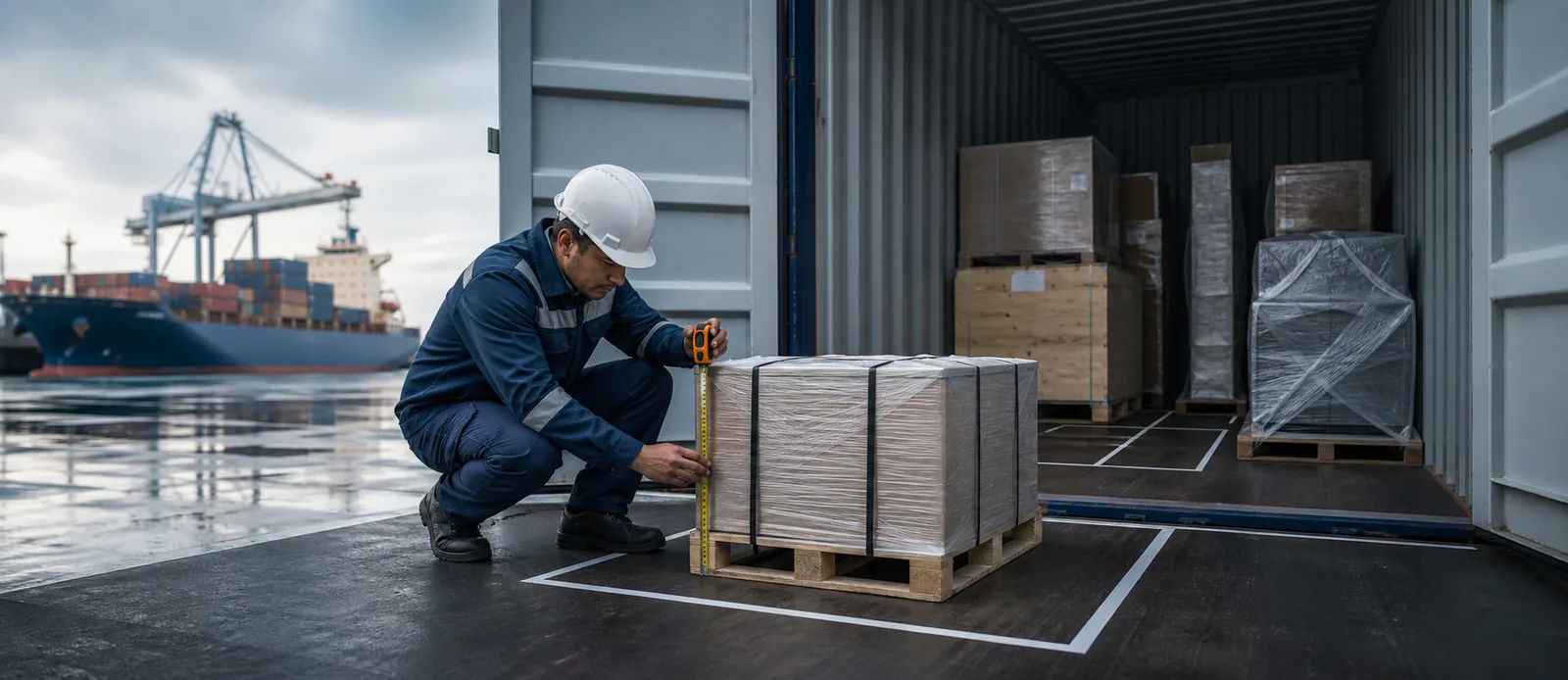
- Measure your cargo dimensions: Get the length, width, and height of each carton or pallet in centimeters. If you have multiple pieces, measure each one separately.
- Calculate total CBM: For each piece: (L × W × H in cm) ÷ 1,000,000 = CBM. Add up all pieces for total CBM. Example: 10 cartons of 60×40×50 cm = 10 × 0.12 CBM = 1.2 CBM total.
- Check the weight/measure ratio: Divide total weight (kg) by total CBM. If the ratio tops 1,000 kg per CBM, you'll be charged by weight instead. Most consumer goods fall well under this mark.
- Multiply by the per-CBM rate: Take the higher of CBM or weight tons, multiply by the route's per-CBM rate. For 1.2 CBM from China to US West Coast at $120/CBM: 1.2 × $120 = $144 ocean freight.
- Add CFS and ancillary charges: Add origin CFS (~$25/CBM), destination CFS (~$30/CBM), paperwork ($75), and customs clearance ($150-$250). Total for our example: $144 + $30 + $36 + $75 + $200 = ~$485 all-in.
How to Reduce LCL Shipping Costs
- Make your packing tighter — Cut carton size to shrink CBM. Vacuum-seal soft goods, push out excess air, and use the right-sized boxes. Even a few centimeters per carton can save hundreds of dollars on a large shipment.
- Group your orders — Instead of shipping weekly, batch your orders monthly. A single 5 CBM shipment costs less per unit than five 1 CBM shipments, due to minimum charges.
- Ship during off-peak seasons — LCL rates spike October-December (pre-holiday) and before Chinese New Year. Ship in March-May or August-September for the best rates.
- Consider FCL at the break-even point — If your LCL quote tops ~60-70% of an FCL price, booking a 20ft container is often cheaper. This holds true even if the container isn't full.
- Use a freight forwarder with strong LCL grouping — Forwarders that move high LCL volumes get better rates from consolidators. Ask about their weekly LCL runs on your route.
- Negotiate rates for regular shipments — If you ship LCL monthly on the same route, negotiate a contract rate. Even small commitments can unlock 10-20% savings.
LCL Shipping Process — What to Expect
The LCL process has more steps than FCL, because of the grouping stage. Your cargo gets picked up from the supplier, and delivered to the origin CFS (Container Freight Station). There, it's grouped with other shippers' cargo, and loaded into a shared container. This grouping step adds 3-5 days to your timeline.
At the destination port, the container gets unloaded at the destination CFS, where your cargo gets split from the rest (deconsolidation). You get notified when it's ready for pickup or delivery. This un-grouping step adds another 2-5 days.
Total transit time for LCL = ocean transit + 3-5 days origin CFS + 2-5 days destination CFS + customs clearance. For China to US West Coast: 18-22 days ocean + 5-10 days CFS = 28-38 days total.
India to Germany LCL Rates: Bangalore, Mumbai, and Chennai to Hamburg
LCL from India to Germany runs about US$65–140 per CBM in base freight in 2026, so 10 CBM comes to about US$650–1,400 of ocean freight before inland trucking and destination charges. Bangalore has no seaport: cargo is trucked about 300 km to Chennai or 1,000 km to Mumbai/Nhava Sheva before loading. Plan on 28–35 days from Mumbai/Nhava Sheva to Hamburg, and 30–38 days from Bangalore via Chennai.
Why LCL Rates Vary from $30 to $180 per CBM
LCL pricing swings more than FCL, since it depends on how full each consolidator's container is when it sails. A well-packed load with 50+ cubic meters of cargo spreads fixed costs (container rental, port fees, loading labor) across many shippers, which lowers the per-CBM rate. A half-empty container pushes rates up, since the consolidator still pays full container costs.
Several factors push LCL rates higher. Off-peak season pricing pressure hits in Jan-Feb, right after Chinese New Year, when containers sit half-empty. Destination port congestion adds cost too — think Hamburg and Rotterdam in the Q4 holiday peak. Low-volume destinations that get fewer sailings (once-weekly vs twice-weekly) also cost more. Hazmat or special handling cargo raises the price. So do short lead-time bookings that miss the best consolidation windows.
Other factors lower LCL rates. Booking during high-volume peak windows helps (Sep-Nov out of China). So does picking high-frequency corridors — Shanghai → Los Angeles runs daily consolidation. Using less-congested ports also helps, like Bremerhaven instead of Hamburg, or Felixstowe instead of Southampton. Combining multiple shipments into one weekly pickup window helps too.
LCL Shipping FAQ
Sources and scope (checked 12 September 2026)
- DHL — LCL cost components — Educational explanation of W/M and charges; not Suaid prices.
- DHL — Brazil terms, 20 April 2026 — Billing rules can differ by charge. These are DHL terms, not Suaid terms.
- DHL — LCL and CFS process — Container sharing, consolidation and deconsolidation; no service commitment.
- DHL — Comparing LCL and FCL — Distinguishes sailing time from handling; no fixed transit time adopted.
- IMO — IMDG Code — Requirements for packaged dangerous goods; confirm acceptance for the selected service.
- FreightAmigo — LCL, 2026-07-23
- Clearit — USA pricing, 2026-09-12
Explore more on these topics
Related Topics & Categories
Build an LCL budget with a clear scope
Use the same cargo details, endpoints and service boundary when comparing offers. Identify ocean freight, CFS handling, documents, customs services and inland transport. Check which items are included before adding any further charges.
Confirm the W/M basis, minimum, rounding and validity for each quoted charge. List exclusions and currencies. Ask separately for cargo acceptance, the proposed sailing and booking confirmation; a price quote alone does not reserve space.
- Ocean freight basis and minimum
- Origin pickup, export handling and CFS
- Destination CFS, customs and final delivery
- Validity, free time and excluded extras