
Importing Auto Parts to Brazil: Complete Guide 2026
Summary: Brazil is the world's 8th largest auto market, and one of the toughest to crack. It imports over $12 billion in auto parts every year. This guide walks you through the whole import process — from HS classification all the way to customs clearance.

Brazil's Auto Industry & Import Landscape
Brazil is the world's 8th largest auto market, and the biggest one in Latin America, by a wide margin. It builds about 2.4 million vehicles a year, on its own soil. The country's auto parts market is worth over $40 billion. Imports make up roughly $12 billion of that, a figure that's grown 15% since 2023, as local makers lean more and more on special foreign parts.
The main supplier countries break down like this, roughly speaking. Germany sends transmissions, engine parts, and premium components. Japan sends electronic modules and hybrid tech. China sends commodity parts, body panels, and aftermarket goods, too. The United States sends specialty and heavy-duty parts. Trade runs both ways — see what the US imports from Brazil. Argentina trades parts under the Mercosur automotive deal. China has grown into the second-largest supplier by volume, all thanks to its low prices on aftermarket and replacement parts.
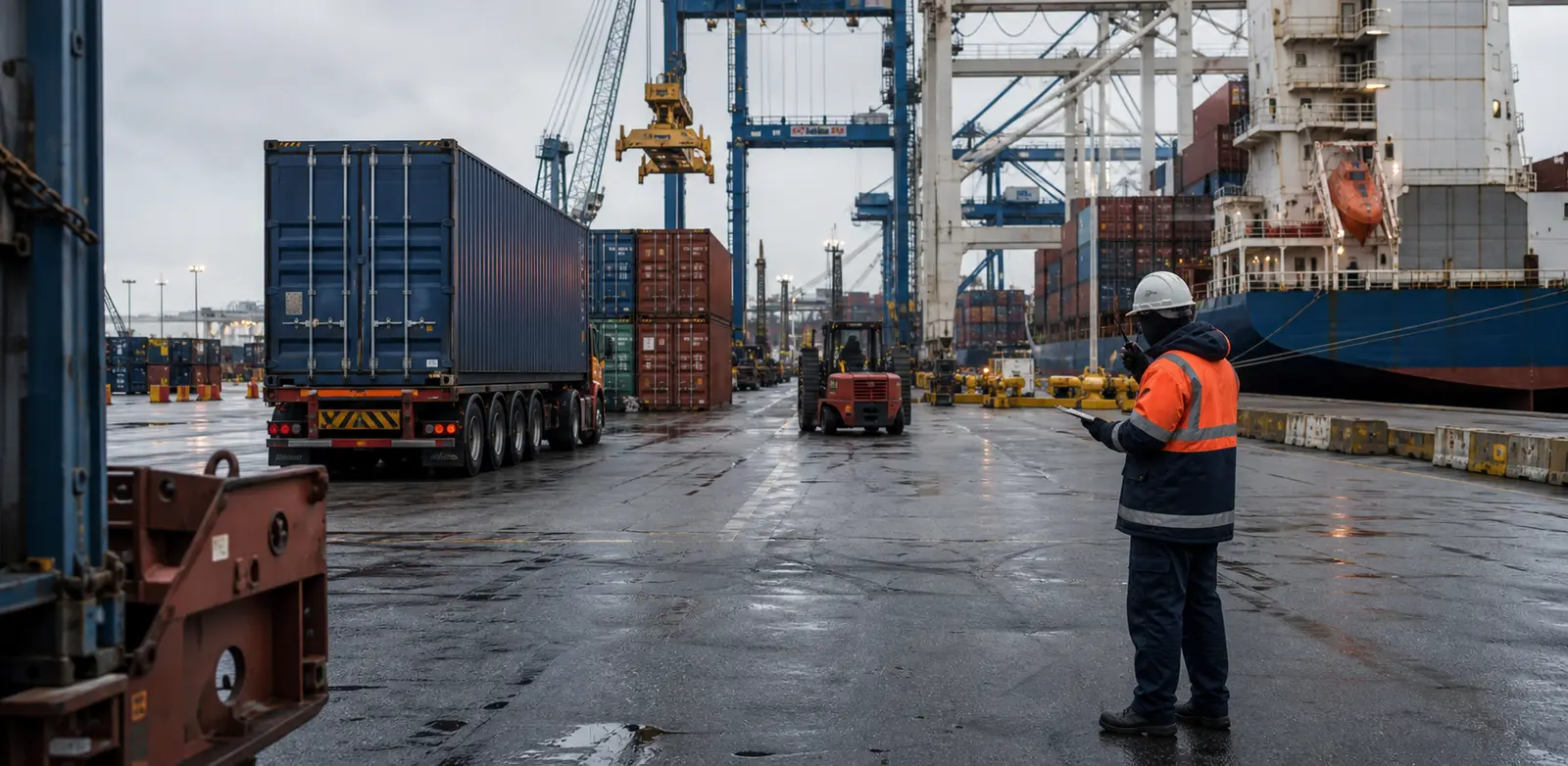
Brazil's auto supply chain sits mostly in four states: São Paulo, Minas Gerais, Paraná, and Rio Grande do Sul. Most imports come in through the Port of Santos (SP), the Port of Paranaguá (PR), and Guarulhos Airport (GRU) for air freight. The ICMS tax rate varies quite a bit by entry point. Knowing this gap ahead of time can change your total landed cost a lot.
HS Classification for Auto Parts
Getting your HS (Harmonized System) code right is the single biggest factor in your import costs, hands down, more than anything else you could do. Most auto parts fall under Chapter 87 of the HS code. HS 8708 covers 'Parts and accessories of motor vehicles.' Get this wrong, and you could overpay duties by 5-15% — or worse, face customs fines and shipment delays.
| HS Code | Description | Import Duty (II) |
|---|---|---|
| 8708.10 | Bumpers and parts thereof | 18% |
| 8708.21 | Safety seat belts | 16% |
| 8708.30 | Brakes and servo-brakes; parts thereof | 16% |
| 8708.40 | Gear boxes and parts thereof | 16% |
| 8708.50 | Drive axles with differential; non-driving axles | 16% |
| 8708.70 | Road wheels and parts/accessories thereof | 18% |
| 8708.80 | Suspension systems and parts thereof | 14% |
| 8708.91 | Radiators and parts thereof | 16% |
| 8708.95 | Safety airbags with inflater system | 14% |
| 8708.99 | Other parts and accessories | 16% |
Import Duties & Taxes Breakdown
Brazil runs one of the most complex import tax systems in the world, full stop, no argument there at all. Your total tax bill on auto parts typically runs 60% to 80% of CIF value. This depends on the specific part, its HS code, and the state it lands in. You need to understand each tax layer well, to plan your costs right.
| Tax | Rate Range | Calculation Base | Notes |
|---|---|---|---|
| II (Imposto de Importação) | 14-18% | CIF value (cost + insurance + freight) | Federal import duty; rate depends on HS code |
| IPI (Imposto sobre Produtos Industrializados) | 5-25% | CIF + II | Federal excise tax; higher for finished assemblies |
| PIS (Programa de Integração Social) | 2.10% | CIF value | Federal social tax |
| COFINS (Contribuição para Financiamento da Seguridade Social) | 9.65% | CIF value | Federal social security tax |
| ICMS (Imposto sobre Circulação de Mercadorias e Serviços) | 12-18% | CIF + II + IPI + PIS + COFINS | State tax; varies by state (SP 18%, PR 18%, MG 18%) |
| AFRMM (Additional Freight Charge) | 8% | International ocean freight cost | Applies only to ocean freight shipments |
Here's a real example, worked out step by step. Say you import brake components (HS 8708.30) from Germany, with a CIF value of $10,000. The import duty (II) at 16% adds $1,600. IPI at 8% on $11,600 adds $928. PIS/COFINS at 11.75% on $10,000 adds $1,175. Then ICMS at 18% (São Paulo) gets figured on the full inclusive base, adding about $4,200. Total taxes: roughly $7,900 — that's a 79% effective rate on the CIF value.
These rates make Brazil one of the priciest countries in the world for auto parts imports, no question at all. That's exactly why trade agreements, correct classification, and duty-cutting tools matter so much, if you want to keep your prices competitive.
Mercosur & Trade Agreement Benefits
Mercosur's Common External Tariff (TEC) sets the base import duty for auto parts coming into Brazil from non-member countries. But several two-country and multi-country deals offer big duty cuts on top of that. These can lower your landed cost by a lot.
Argentina, by far, is the best origin for auto parts entering Brazil, no other place is close. Under the Mercosur automotive deal (Policy 39/II) and the bilateral ACE 14, most auto parts from Argentina enter Brazil at zero import duty, plain and simple. You just need to meet Mercosur origin rules — usually 60% regional content. This makes Argentina a smart sourcing hub for firms that supply the Brazilian market, year after year. Keep this in mind.
The ACE 55 deal between Brazil and Mexico gives special tariffs for auto parts, too, on top of everything else. Many items qualify for reduced or zero duty under this deal. This matters most for firms sourcing from Mexico's big auto-making sector. To claim the benefit, your parts must meet specific origin rules. They must also carry a valid Certificate of Origin from an approved body in Mexico, without fail.
The EU-Mercosur Free Trade Agreement got a nod of political agreement back in 2019. It's still waiting on final ratification, though, as of early 2026, all these years later. Once it's ratified, it will phase in lower tariffs on European auto parts over 10-15 years, in time, hitting zero duty for most HS 8708 items. If you source from Germany, Italy, or France, keep a close eye on how ratification moves along, month by month. Stay updated.
Customs Clearance Process
Every single import into Brazil must go through Siscomex (Sistema Integrado de Comércio Exterior), the federal government's own trade system. You, as the importer, file a DI (Declaração de Importação) online, and attach all the papers required, no shortcuts. Customs then sorts your filing into one of four separate inspection channels.
Green channel — that's automatic release — takes 1-3 business days, and only applies to low-risk importers with a clean record and low-risk goods. Yellow channel — document review only — takes 5-8 business days; a customs officer checks all your papers, but doesn't open the cargo at all. Red channel — document review plus a physical check — takes 10-15 business days, the longest path of the three. This means officers open containers and check contents against your declaration.
For safety-critical auto parts, you must get INMETRO (Instituto Nacional de Metrologia) certification before you import, no exceptions at all, ever. This covers brakes, tires, glass, seat belts, child restraints, lighting, and mirrors, one and all. INMETRO certification takes 60-120 days, and you must finish it before your goods ship. Parts that arrive without the right INMETRO certificate get held at customs for good, or sent back to origin.
Import licenses (LI — Licença de Importação) are required for certain auto parts types, mostly those under INMETRO rules or with restricted materials inside. Non-automatic licenses must get approved before you ship, and this typically takes 10-30 days through Siscomex, start to finish. Working with a customs broker who really knows auto imports well can cut your clearance time by 30-50%, sometimes even more. Choose wisely.
Shipping Modes Compared
For most auto parts importers, ocean freight is the main mode for regular stock restocking, day in and day out, week after week. A 20ft container can hold about 8,000-12,000 kg of auto parts, depending on density. If you ship less than 10 CBM per order, look into LCL (Less-Than-Container Load) grouping instead. That way, you don't pay for empty container space.
Air freight matters most when things go wrong — especially line-down cases, where one missing part stops a whole production line, dead in its tracks. At $4-$8 per kg, air freight costs 15-30 times more than ocean, per unit of weight, quite a jump. But its 2-4 day transit time, versus 25-40 days by ocean, can save you from production losses worth far more than that freight premium.
| Factor | Ocean Freight (FCL/LCL) | Air Freight |
|---|---|---|
| Best for | Bulk orders, planned inventory replenishment | Urgent orders, line-down situations, prototypes |
| Transit time | 25-40 days (depending on origin) | 2-4 days door-to-door |
| Cost per 20ft container | $1,800-$5,000 (varies by origin) | N/A (priced per kg) |
| Cost per kg | $0.10-$0.30/kg (for full containers) | $4-$8/kg (general cargo rates) |
| Minimum shipment | 1 CBM (LCL) or 1 container (FCL) | No practical minimum |
| Port of entry | Santos (SP), Paranaguá (PR), Itajaí (SC) | Guarulhos (GRU), Viracopos (VCP), Manaus (MAO) |
| Customs clearance | 5-15 business days average | 3-7 business days average |
| Typical use case | Regular inventory, aftermarket parts, OEM supply | Production line stoppage, prototype parts, samples |
Cost Breakdown by Origin Country
The Argentina edge is huge, plain and simple, no matter how you slice it. Cutting out the 14-18% import duty helps a lot on its own. Add lower freight costs from being close by, and your total landed cost can drop by 20-30%, versus sourcing the same part from China or Germany. This is exactly why so many big OEMs keep assembly or finishing plants in Argentina, just to serve the Brazilian market under Mercosur rules. It just makes sense.
For parts from China, the market's lowest ocean freight rates get partly offset by the full TEC duty rate, plus longer transit times, too. Still, for aftermarket and commodity parts with low unit value, Chinese makers' low prices still win out, in the end. They usually give you the lowest per-unit landed cost, most of the time.
| Origin Country | Ocean Freight (20ft) | Air Freight (per kg) | Import Duty (II) | Total Landed Cost Estimate |
|---|---|---|---|---|
| Germany | $2,500-$4,000 | $5.50-$7.50/kg | 14-18% | CIF + 70-80% taxes |
| Japan | $3,000-$5,000 | $5.00-$7.00/kg | 14-18% | CIF + 70-80% taxes |
| China | $1,800-$3,500 | $4.00-$6.00/kg | 14-18% | CIF + 70-80% taxes |
| United States | $2,200-$3,800 | $4.50-$6.50/kg | 14-18% | CIF + 70-80% taxes |
| Argentina (Mercosur) | $800-$1,500 (truck/short sea) | $3.00-$5.00/kg | 0% (with origin certificate) | CIF + 40-55% taxes (no II) |
| Mexico (ACE 55) | $2,000-$3,500 | $4.50-$6.50/kg | 0-8% (special rate) | CIF + 50-70% taxes |
How to Reduce Auto Parts Import Costs
- Optimize HS classification for the lowest rate you can get: Work with a customs broker who knows this well, to make sure each part gets the best HS subheading it can get. The gap between HS 8708.80 (suspension, 14%) and 8708.99 (other parts, 16%) is just 2 percentage points, not much at all. But on a $100,000 shipment, that saves $2,000 in import duty alone — and it compounds through the IPI and ICMS math, too.
- Leverage Mercosur and bilateral trade agreements: Source from Argentina (zero duty under Mercosur) or Mexico (reduced duty under ACE 55), whenever you can manage it. Make sure your supplier gives you a valid Certificate of Origin that meets the deal's own origin rules — usually 60% regional content for Mercosur. Even shifting just part of your sourcing can save you a lot, over time.
- Use bonded warehouses (Entreposto Aduaneiro): Bring parts into a bonded warehouse, where you can store them for up to 1 year without paying duties or taxes, none at all. You only pay duties once you pull goods out for use, and not a day before that, ever. This helps your cash flow a lot, and lets you time withdrawals to match production needs, which cuts your inventory carrying costs. Simple as that.
- Combine shipments to reduce per-unit freight costs: Instead of shipping small orders often, group them into bigger shipments. A full 20ft container costs $1,800-$5,000, no matter how full it is, empty or packed. So shipping at 90%+ fill cuts your per-unit freight cost a lot, quite a lot. Work with your freight forwarder, and batch orders from the same origin together.
- Apply for Ex-Tarifário duty reduction: For special auto parts with no Brazilian-made equal, apply to MDIC (Ministry of Development) for Ex-Tarifário status, first thing. This temporarily cuts your import duty down to just 2%, quite a drop. This filing takes 4-6 months, but it can save 12-16% on duty for parts that qualify. This works best for high-tech parts, like advanced sensor modules or electric vehicle parts, where margins run thin.
- Implement JIT delivery to reduce inventory costs: Work with your freight forwarder to set up a just-in-time delivery schedule. This keeps your warehouse stock low, all year round, month after month. Mix ocean freight for regular stock with air freight for urgent top-ups, side by side. This combo can cut your total logistics costs by 10-20%, versus keeping large safety stock on hand, quarter after quarter. Worth trying.