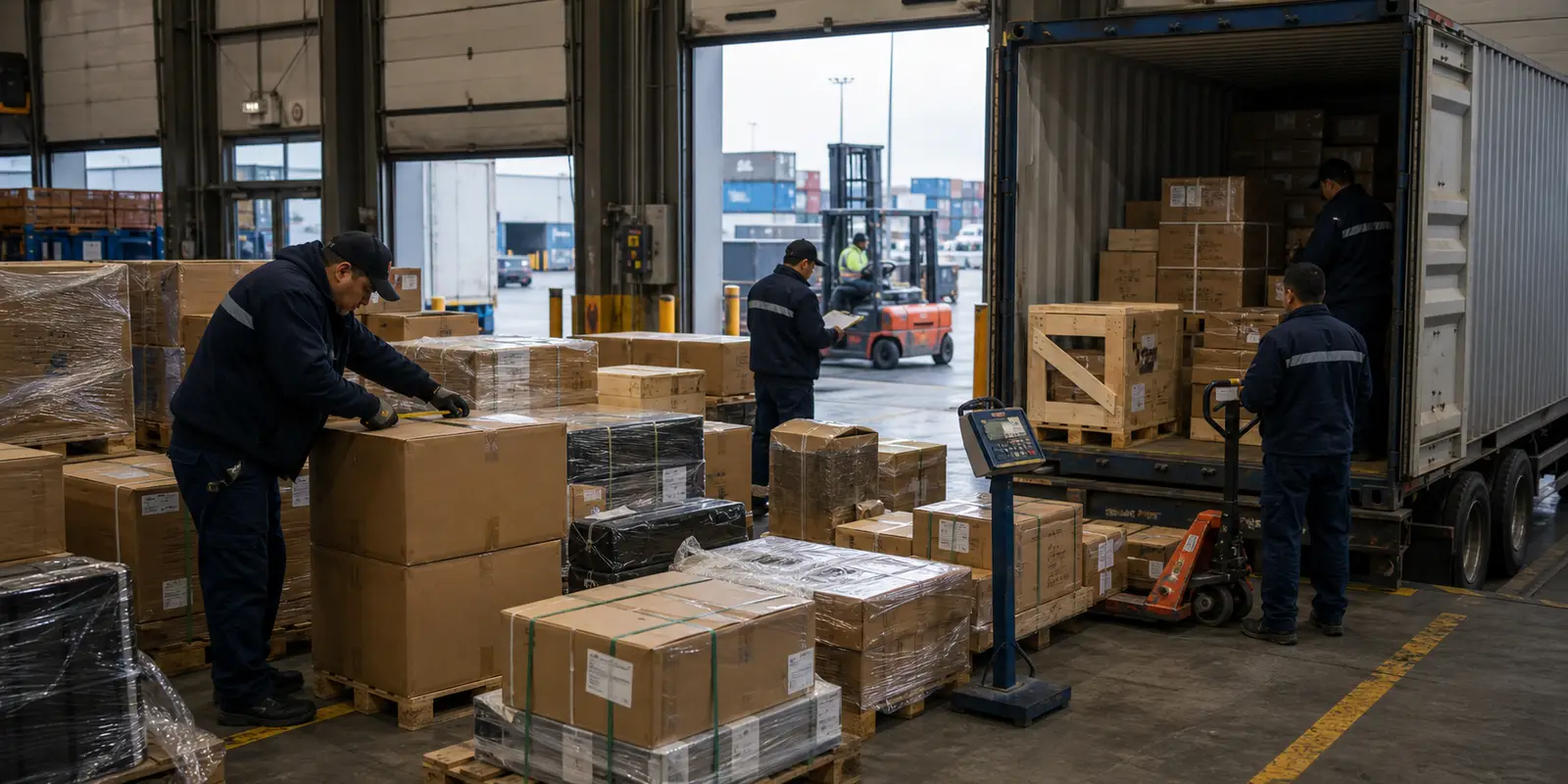

LCL Container Guide: Types, Sizes & Loading
Summary: Not all containers are the same size. You need to know the exact size, weight limits, and how to load 20ft, 40ft, and High Cube boxes. This guide covers what you need for LCL consolidation.

Container types used for LCL consolidation
LCL consolidation uses standard ISO shipping boxes. The two most common sizes are 20-foot (TEU) and 40-foot (FEU). More shippers now also pick 40ft High Cube boxes for bulky loads.
Each box type has its own size, weight limit, and load traits. These factors set how much cargo fits, and how tight you can pack it.
Standard container dimensions and specifications
| Container Type | External Length | External Width | External Height | Internal Length | Internal Width | Internal Height | Door Opening |
|---|---|---|---|---|---|---|---|
| 20ft (TEU) | 6.06m (20') | 2.44m (8') | 2.59m (8'6") | 5.87m (19'3") | 2.35m (7'8") | 2.39m (7'10") | 2.29m × 2.28m |
| 40ft (FEU) | 12.19m (40') | 2.44m (8') | 2.59m (8'6") | 12.03m (39'5") | 2.35m (7'8") | 2.39m (7'10") | 2.29m × 2.28m |
| 40ft HC (High Cube) | 12.19m (40') | 2.44m (8') | 2.89m (9'6") | 12.03m (39'5") | 2.35m (7'8") | 2.70m (8'10") | 2.29m × 2.28m |
Usable volume (CBM) and weight limits
| Container Type | Usable Internal CBM | Maximum Gross Weight | Tare Weight (Empty) | Maximum Payload Weight |
|---|---|---|---|---|
| 20ft Standard | 33.1 CBM | 24,000 kg | 2,200 kg | 21,800 kg |
| 40ft Standard | 67.7 CBM | 30,480 kg | 3,800 kg | 26,680 kg |
| 40ft High Cube | 76.3 CBM | 30,480 kg | 4,000 kg | 26,480 kg |
How LCL cargo is loaded and arranged inside containers
LCL consolidation needs careful stowage planning. Cargo from many shippers must fit in tight and stay safe. The total weight must also spread out evenly. This stops damage in transport.
The consolidator plans the load like a 3D puzzle. Heavy items go on the bottom. Light or fragile items go on top. Cardboard dividers or plywood sheets keep each shipper's cargo apart. Dunnage — wood blocks, foam strips, or straps — stops cargo from shifting.
Weight spread is key. The box's center of gravity must stay within safe limits for the trip at sea. If too much weight sits on one side, the box can tip. That can also damage the cargo.
Consolidators also work to use all the space. They stack pallets, add pallet racks inside the box, and place cartons to cut down empty gaps. A well-planned load can fill 85-95% of the box.
Maximum volume and weight limits per shipment
LCL lets you ship almost any size load. Still, real limits apply.
Minimum size: Most consolidators take loads as small as 0.5 to 1 CBM. Below that, handling fees cost more than you save on freight.
Maximum size: A single LCL load can reach 20 CBM. On some routes, it can go up to 25 CBM. Past that point, FCL often costs less. The exact cutoff shifts by route. Busy lanes like China-USA may cap out at 12-15 CBM. Quiet routes can go up to 18-20 CBM.
Weight limits: Most consolidators set a 5-ton cap per LCL load. Go over that, and you must split the load or switch to FCL. Why the cap? Heavy loads can throw off the balance of the box.
Real-world range: Most shippers use 2-15 CBM. This range gives the best value for LCL. Below 2 CBM, handling fees eat up your savings. Above 15 CBM, FCL starts to look like the better deal.
Packing and prep rules for LCL
How you pack your cargo affects both speed and safety in consolidation. LCL cargo gets handled more than FCL. So your packing must be strong and solid.
Pallet and stacking rules
- Pallets must use standard sizes. Use 1200×1000mm (EUR or ISO pallet) or 1200×1200mm (US standard). Odd-size pallets make consolidation harder.
- Max stack height: Keep pallet stacks no taller than 1.5-1.8 meters. Box height limits and weight rules set this cap. Test how strong your boxes stack before you ship.
- Secure the top pallet: A top pallet can shift if it's not tied down well. Use straps, shrink wrap, or corner guards to hold it in place.
- Cut empty space: If your load doesn't fill a full pallet, ask your consolidator. They may fill the gap with other cargo in the same load.
- Pallet fit: Consolidators often use set pallet racks. If your load needs special care — like temp-controlled pallets — ask for it up front. It may cost extra.
Export packing and marking rules
- Use strong corrugated boxes, not thin ones. Mark each box with clear text: shipper name, consignee name, the ship-to address, and the HS code if the goods are hazardous.
- Write the weight on the top and sides of each box. This makes it easy to spot during load and unload.
- Use colored tape or stickers to tell shipments apart inside the box. Some consolidators use a color code — red for shipper A, blue for shipper B, and so on.
- Fragile marks: Write 'FRAGILE' and 'THIS SIDE UP' on boxes with items that can break. Consolidators do follow these marks.
- Avoid loose nails, sharp edges, or loose parts. These can damage other loads nearby. Seal each box well. Open boxes can't go into a shared load.
- List the weight in both kg and lbs. This keeps it clear for all countries.
- Add a packing list to the outside of each shipment. It should show the box or pallet count and total weight.
How to work out CBM for LCL pricing
LCL freight rates are based on CBM (cubic meters). Your cost depends on which number is higher: the CBM or the weight in tons. This rule stops shippers from low-balling volume to get a cheaper rate.
The formula is simple: Length (m) × Width (m) × Height (m) = CBM.
For example, take a box that measures 1.2m (L) × 1.0m (W) × 0.5m (H): 1.2 × 1.0 × 0.5 = 0.6 CBM.
For a pallet with boxes on top, measure the base size plus the stack height. Say you have a 1200×1000mm pallet with boxes stacked 1.2m high: 1.2 × 1.0 × 1.2 = 1.44 CBM.
When you work out CBM, round up to the next 0.1 CBM. So a 0.65 CBM load rounds up to 0.7 CBM on the bill.
Weight rule: 1 ton counts the same as 1 CBM for billing weight. If your cargo weighs 2 tons but is only 1.5 CBM, you pay for 2 CBM — the higher of the two.
Worked example: CBM calculation
Example 1 — Boxes on pallet:
Pallet: 1200mm × 1000mm × 200mm (pallet itself)
Boxes stacked on pallet: 5 boxes × 0.3m height = 1.5m total height
Total height = 0.2m + 1.5m = 1.7m
CBM = 1.2m × 1.0m × 1.7m = 2.04 CBM, rounded to 2.1 CBM
Weight: All 5 boxes = 400 kg = 0.4 tons
Chargeable weight: 2.1 CBM (volume is higher than weight)
Example 2 — Heavy cargo:
Single wooden crate: 1.0m × 0.8m × 0.6m = 0.48 CBM, rounded to 0.5 CBM
Weight: 3 tons (heavy machinery inside)
Chargeable weight: 3 CBM (weight is higher than volume)
You pay for 3 CBM worth of freight, not 0.5 CBM.
Special boxes for LCL: reefer and open-top
Most LCL loads use standard dry boxes. But special box types exist for certain cargo types.
Reefer boxes (refrigerated): these carry goods that can spoil, like fruit, fish, or frozen items. A reefer box holds a set temp, often -18°C to +25°C. It costs 20-40% more than a standard box. Reefer consolidation is rare. Why? Different goods often need different temps, and that's hard to mix in one box.
Open-top boxes: these have a canvas roof you can remove, not a solid top. Use them for tall loads that don't fit a standard box — think machinery or big frames. Open-tops rarely work for LCL. The whole load must match the open-top setup, and that's a rare fit.
Flat-rack boxes: these have fold-down sides for oversize loads. They rarely fit into a shared LCL load.
For most LCL shippers, a standard dry box (20ft or 40ft) is the only real choice. Special boxes need special set-up, and that usually means FCL, not LCL.