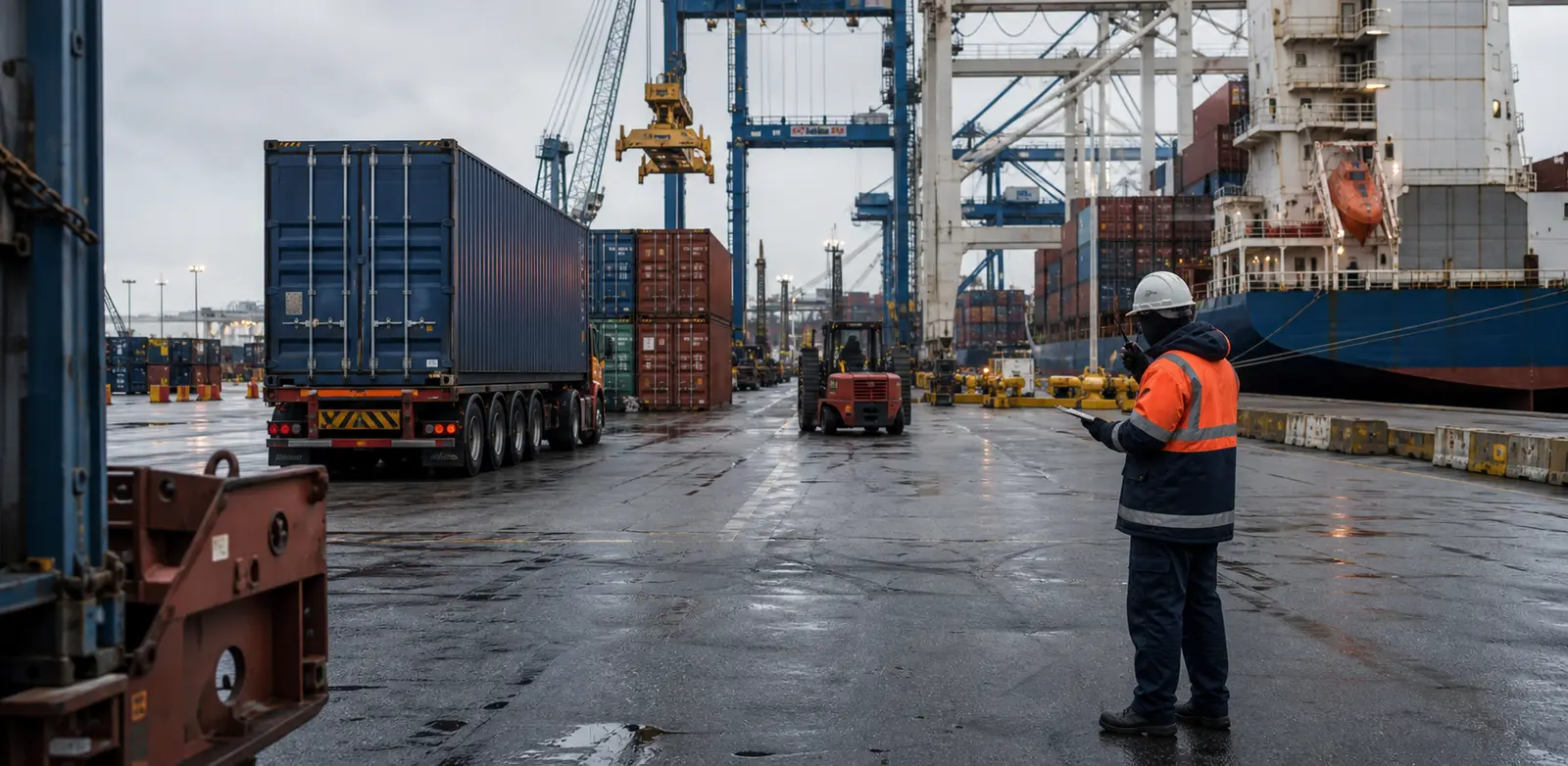

What is Freight Forwarding?
Summary: A freight forwarder is the architect of global logistics. They coordinate the movement of goods across borders, managing carriers, customs, paperwork, and delivery — so you don't have to.

What is a freight forwarder?
If you're reading this, you're probably one shipment into a discovery: moving goods across borders is not a single service. It's a stack of services that somebody has to sequence in the right order. That somebody is the freight forwarder. We run Suaid Global as an asset-light orchestrator of that exact sequence across 40+ country pairs. The overview below shows how the role really works in 2026.
A freight forwarder is a company that organizes and manages the shipment of goods on behalf of importers and exporters. They act as the go-between for the shipper and the transport services needed to move cargo from origin to destination. That covers ocean carriers, airlines, trucking companies, railroads, and customs bodies.
Think of a freight forwarder as a travel agent for your cargo. Instead of flights and hotels, they book vessel space, arrange trucking, and handle customs clearance. They manage the paperwork and run the whole door-to-door chain.
At its core, freight forwarding is a logistics service that manages the transport of goods across borders. Freight forwarders move cargo by air, ocean, rail, and road. They handle everything from rate talks to customs clearance and cargo insurance. They sit between shippers and carriers and make freight simple for firms of all sizes.
What does a freight forwarder do?
A freight forwarder's role spans the whole supply chain. Here are the core services a modern forwarder provides:
- Carrier selection and booking — negotiating rates with ocean lines, airlines, and trucking companies
- Shipping documents — preparing Bills of Lading, commercial invoices, packing lists, and certificates of origin
- Customs brokerage — filing customs entries, managing HS codes, and working with government agencies
- Cargo insurance — arranging the right cover for goods in transit
- Warehousing and distribution — providing storage, cross-docking, and last-mile delivery
- Supply chain consulting — improving routes, cutting costs, and speeding up transit
- Cargo tracking — real-time updates on shipment status and location
- Compliance — keeping shipments in line with trade rules, sanctions, and import/export laws
How does freight forwarding work?
- Quote and booking: The process starts when you request a quote. The forwarder reviews your cargo (dimensions, weight, commodity, origin, destination) and quotes rate options across modes — ocean, air, or ground.
- Documentation preparation: Once booked, the forwarder prepares all required shipping documents — commercial invoice, packing list, and Bill of Lading or Air Waybill. It also secures any special certificates or permits needed for your cargo type.
- Cargo pickup and origin handling: The forwarder arranges pickup from your warehouse or factory, handles any export customs steps, and delivers the cargo to the port or airport.
- International transport: Your cargo moves via ocean vessel, aircraft, or a combination of modes. The forwarder tracks the shipment and gets ahead of any delays or holdups.
- Customs clearance at destination: The forwarder's customs broker files the import entry and pays duties and taxes on your behalf. It also works with any government agencies (FDA, USDA, etc.) for cargo release.
- Final delivery: After customs clearance, the forwarder arranges last-mile delivery — drayage from the port, deconsolidation if LCL, and trucking to your warehouse or distribution center.
Freight forwarder vs customs broker vs carrier
Knowing the difference between these three roles is key:
| Role | What They Do | Example |
|---|---|---|
| Freight Forwarder | Manages the whole shipment from door to door | Suaid Global |
| Customs Broker | Files customs entries and manages import compliance | Often part of the freight forwarder's team |
| Carrier | Moves the cargo itself (vessel, plane, truck) | Maersk, MSC, FedEx, UPS |
| NVOCC | Issues own Bill of Lading, consolidates cargo | Some freight forwarders are also NVOCCs |
How much does freight forwarding cost?
Freight forwarding costs vary widely by mode, trade lane, cargo type, volume, and service level. Here are the main cost components:
| Cost Component | Typical Range | Notes |
|---|---|---|
| Ocean freight (FCL 40') | $1,500 – $8,000 | Varies by lane and season |
| Ocean freight (LCL per CBM) | $40 – $120 | Plus origin/destination handling |
| Air freight (per kg) | $2 – $8 | Based on chargeable weight |
| Customs brokerage | $150 – $400 | Per entry, complexity-dependent |
| Trucking/drayage | $300 – $1,500 | Distance and equipment type |
| Documentation fees | $50 – $150 | Per shipment |
| Cargo insurance | 0.2% – 2% of value | Commodity and route dependent |
How to choose the right freight forwarder
- Licensed and bonded — verify FMC (Federal Maritime Commission) license for ocean freight and customs broker license
- Industry experience — look for forwarders with real depth in your commodity and trade lanes
- Technology and visibility — modern forwarders offer real-time tracking, digital documents, and online quoting
- Global network — ensure they have partners and offices in your key origin and destination countries
- Customs expertise — in-house customs brokerage is a big advantage over outside brokers
- References and track record — ask for client references in your industry and check their claims handling reputation
- Communication — fast, proactive updates matter most when something goes wrong mid-shipment
Why work with Suaid Global
Suaid Global is an asset-light freight orchestration platform focused on cargo to and from the United States. We manage ocean freight, air freight, customs brokerage, warehousing, and ground transport through a vetted network of licensed partners. You get one integrated service, with no owned carriers and no conflicts of interest.
Suaid Global works with importers of every size. Whether you ship one LCL pallet or run complex multi-modal project cargo, we coordinate each shipment with the same care, skill, and accountability.
When Do You Need a Freight Forwarder?
Not every shipment needs a forwarder. Small parcels move fine through postal and courier networks. The tipping point usually comes with size, value, or rules. Watch for these signs:
- Your shipment passes 150-200 kg — courier prices climb fast above this range, while freight rates drop per kilo.
- Your goods need customs review — food, electronics, chemicals, and textiles often call for permits or extra filings.
- Your route has more than one leg — factory to port, ocean crossing, customs, then trucking is a lot to run alone.
- Your cargo needs special care — oversize loads, temperature control, or dangerous goods all need expert handling.
- Your time has better uses — chasing carriers and filings is real work; see our guide to freight forwarding for small business.
How Forwarders Price Their Work
Forwarders earn money in two main ways. They buy freight space at one rate and sell it at another. They also charge fixed fees for set tasks, like customs entries or document prep.
That margin is not waste. A good forwarder buys space better than most shippers can on their own. So the total bill often comes in lower than booking direct, even after the markup.
The key is to compare quotes on the same terms: same route, same service level, same fee lines. Ask for the all-in number, never just the base rate. Our freight forwarding cost guide breaks down each fee line by line.
How many quotes should you get? Two are enough to spot an outlier. Three give you a fair view of the market. Past that, you trade your time for pennies.
Freight Forwarding in 2026: What Has Changed
Three shifts shape the market as of mid-2026. First, digital quoting is now table stakes. Most forwarders can price a standard lane in hours, not days, and give online tracking as standard.
Second, customs got heavier. The US ended the de minimis exemption for low-value parcels, and tariff rates moved several times in 2025 and 2026. That pushed many sellers from parcel models toward bulk freight, and made entry filings more complex.
Third, rates stay volatile. Red Sea routing and shifting capacity mean prices on some lanes can swing 20-30% in a quarter. Budget with ranges, not single numbers — our 2026 shipping costs guide tracks the current ones.
Five Mistakes First-Time Importers Make
- Booking on price alone — the cheapest quote often leaves out destination fees that show up on a later invoice.
- Skipping cargo insurance — standard carrier liability is tiny next to the value of most loads; see our cargo insurance guide.
- Guessing HS codes — the wrong code means the wrong duty rate, and penalties cut both ways.
- Leaving no time buffer — ports jam up and customs holds happen; pad your timeline by two weeks.
- Ignoring the trade terms — know your Incoterm and who pays each leg; our Incoterms 2020 guide explains the split.
Questions to Ask Before You Book
A short call answers most of these. How a forwarder responds tells you as much as the answers themselves.
Want a starting point? Send your route and cargo details through the quote form. You will get clear numbers and a clear scope — and you can hold us to the list above.
- Are you licensed for my mode and lanes (FMC, customs broker)?
- What exactly does this quote include, and what gets billed later?
- Who handles customs at destination — your team or a partner?
- How do I track my shipment, and who do I call when it stalls?
- Can you share a reference from my industry?
- What happens if my cargo is damaged or delayed?